Posts

How boredom can lead to your most brilliant ideas | Manoush Zomorodi

Image
How boredom can lead to your most brilliant ideas | Manoush Zomorodi (TED Talk; April 2017; Vancouver BC) 16' Do you sometimes have your most creative ideas while folding laundry, washing dishes or doing nothing in particular? It's because when your body goes on autopilot, your brain gets busy forming new neural connections that connect ideas and solve problems. Learn to love being bored as Manoush Zomorodi explains the connection between spacing out and creativity. Related : (Ap)prendre le temps ? Il faut savourer l'ennui (France Culture) On Being Bored (Phillips)   'Boring' is not a critical argument   Boredom (Charney) “ La Peur de l'Ennui ” (anonymous Cahiers reader)

Slow Cinema video essay & Kaili Blues

Image
What Is Duration? Understanding Slow Cinema Through KAILI BLUES A video bricolage-essay by Ryan Swen (YouTube 29 May 2018) 9'15" A mix between a straightforward video essay and a more abstract collage, this video briefly delves into the loose movement known as slow cinema, using the 2015 Chinese film KAILI BLUES, directed by Bi Gan, as a focusing lens. Equal emphasis is given to analysis and creation of a mood befitting the subject matter. Source : "Slow cinema" (ToBeContd) Zachary Lewis, Michael Sicinski (2014) [offline:accessible on Web Archive ] "Slow Wars" (n+1) Moira Weigel (spring 2016) n+1 podcast 29 : "Slow Wars" with Moira Weigel (10 September 2016) 33' 'Kaili Blues' Q&A | Bi Gan | New Directors/New Films 2016 (YouTube 33') Director Bi Gan discussed his film 'Kaili Blues' after its screening at New Directors/New Films 2016, co-presented by the Film Society of Lincoln Center and the M...

Miksang and Contemplative Photography

Image
Quiet Mind - Introduction to Miksang and Contemplative Photography Co-production Canada-Singapore. 2003. (11') "Miksang is a Tibetan word meaning "good eye." It represents a form of contemplative photography based on the Dharma Art teachings of Chögyam Trungpa, in which the eye is in synchronisation with the contemplative mind. The result of this particular perception of the world, combined with photography, produces a peculiar and open way of seeing the world. Miksang pictures tend to bring the observer back into the original contemplation state of the author of the picture. The pictures can bring one back to a purer perception of reality that is often neglected. Miksang involves nothing fancy, no special setup; only a visual capture, in the proper state of mind, of everyday's reality" ( Wikipedia ) (Photo by  Julie DuBose ) (PAJ Photography) (Photo by   Julie DuBose ) (photo by April Siegfried) Miksang.com  (Julie DuB...

Rethinking Transcendental Style in Film | Paul Schrader

Image
Fuller Studio : 26 April 2018 Paul Schrader : "Tarkovsky's films mark a deviding point in the history of Durational Cinema. Before Tarkovsky, the use of withholding and distancing devices which Deleuze calls "Time Image", took place in the context of commercial theatrical cinema. Transcendental Style falls into this category. After Tarkovsky the use of these devices became increasingly exagerated, and their films fell into the domain of film festivals and art museums. The 3 sec Bresson's shot of a door became a 10 min static view of traffic. Transcendental Style had morphed into the hydra-headed monster we call "Slow Cinema". Without going into length, I'd just say that Slow Cinema refers to films of considerable length where very little happens. [...] This is why I say it's outside the perview of commercial cinema. Cinema in my opinion is inherantly narrative." Paul Schrader : "To me when movies move away from their narrati...

TAKARA, La nuit où j'ai Nagé (2018/Manivel/Igarashi/Japan)

Image

CCC Masters : Sergei Loznitsa

Image
Sergei Loznitsa  (Russia) Master of Contemporary Contemplative Cinema Drawing by Benoit Rouilly

CCC Masters : Albert Serra

Image
Albert Serra  (Spain) Master of Contemporary Contemplative Cinema Drawing by Benoit Rouilly

CCC Masters : Abderrahmane Sissako

Image
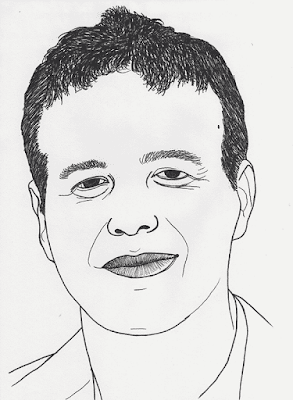
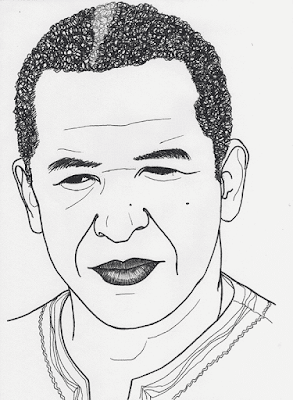
Abderrahmane Sissako (Mauritania) Master of Contemporary Contemplative Cinema Drawing by Benoit Rouilly

CCC Masters : Aleksandr Sokurov

Image
Aleksandr Sokurov (Russia) Master of Contemporary Contemplative Cinema Drawing by Benoit Rouilly

CCC Masters : Apichatpong Weerasethakul

Image
Apichatpong Weerasethakul (Thailand) Master of Contemporary Contemplative Cinema Drawing by Benoit Rouilly

CCC Masters : Wang Bing

Image
Wang Bing (China) Master of Contemporary Contemplative Cinema Drawing by Benoit Rouilly

CCC Masters : Tsai Ming-Liang

Image
Tsai Ming-Liang (Taiwan) Master of Contemporary Contemplative Cinema Drawing by Benoit Rouill y

CCC Masters : Abbas Kiarostami

Image
Abbas Kiarostami (Iran) 1940-2016 Master of Contemporary Contemplative Cinema Drawing by Benoit Rouilly

Khondji & Parreno on "Zidane, un portrait du XXIe siècle" (Cinémathèque 2017)

À PROPOS DE « ZIDANE, UN PORTRAIT DU XXIE SIÈCLE » DIALOGUE AVEC DARIUS KHONDJI ET PHILIPPE PARRENO Video de la conférence à la Cinémathèque française  (18 mars 2017) 1h À la suite de la projection de Zidane, un portrait du XXIe siècle, Philippe Parreno (co-réalisateur) dialogue avec Darius Khondji, directeur de la photographie du film. Rencontre animée par Frédéric Bonnaud. « Zidane c'était du 35, du Super 16 et du numérique HD enregistré avec des Sony 900. Douze caméras étaient en 35 avec de la pellicule 500 Asa poussée d'un diaph ; deux caméras Super 16 à l'épaule et deux Sony 900 équipées de zooms expérimentaux hyperpuissants, construits par Panavision pour l'armée américaine, qui ne pouvaient être montés que sur des caméras numériques. (...) Je suis très attaché aux optiques. Ce n'est pas toujours rationnel, plutôt du domaine de l'inspiration, mais ça a une importance énorme depuis le début de mon travail. Je suis attaché à la forme de la caméra, sa prox...

(Ap)prendre le temps ? Il faut savourer l'ennui (France Culture)

Il faut savourer l'ennui (Conférences France Culture; 26 dec 2017) 57' Mardi des Bernardins du 14 juin 2016 au Collège des Bernardins ( Vimeo ) « Notre territoire s’élargit, notre calendrier rétrécit ; l’horizon recule, la profondeur s’annule ; et les nouvelles générations circulent sur le Web plus facilement que dans la chronologie » Régis Debray, Modernes catacombes, 2013 (Ap)prendre le temps ? - Les mardis des Bernardins from Collège des Bernardins on Vimeo . Travail de mémoire, dictature de l’instant, présent omniprésent ou présentisme… La terminologie du temps s’étend à l’infini. Question de vitesse ou de rythme, d’accélération du temps ou d’essor de l’urgence… à quoi fait-on référence ? Où sont passés les chaînons de la continuité ? Comment réintroduire du temps long notamment dans le temps médiatique ? Peut-on aménager le temps comme on aménage l’espace ? Alors que sous le nom de présent, le contemporain tend à devenir un impératif social et politique, l...