Posts

Showing posts with the label narration

The aesthetic of slow cinema (Silvana Porreca)

"Slow cinema is not merely a stylistic choice — it is a philosophical stance toward time, perception, and the invisible rhythms of human experience. To understand its aesthetic depth, one must explore the broader cultural currents that shaped it: from the alienation of modern relationships to the poetry of consciousness itself." Silvana Porreca; Slow and contemplative cinema: the aesthetic of slow cinema ; in IndieCinema

Sátántangó's Clock (Kinoscope)

Latest addition to the Library page at Unspoken Cinema: "If we need to ascribe it a meaning, it might just be the following. It’s a story I heard Tarr tell in 2011, in Wrocław. I’ve quoted it before, but if you can’t repeat yourself when talking about Tarr, the great master of essence through attrition, then maybe we didn’t absorb anything from him: “A man wakes up at 4:00 AM, dresses, goes out into the darkness to the location of shooting at 6:00 AM. It’s dark, fucking cold, the wind is blowing. It’s raining, and an actor appears, with a hangover too, and with one thousand problems. An actress comes. Her baby was crying all night. A production manager appears. And says what was said at the meteorological institute, the weather forecast. And a man is standing there waiting for the light to go slightly up so one button can be pressed so the scene can be recorded. And if I did not believe you were all going to see it then for what fucking reason would I be doing all this? I am not ...

My review of Abdul Rahman's 8th Street

Image
The old man (Venkatesan) 8th Street (2026/Abdul RAHMAN/India) 1h Film review by Benoit Rouilly for Unspoken Cinema (containing spoilers voluntarily). A clean, well directed piece by Abdul Rahman, who in just one contemplative hour and three cryptic chapters, evokes the devious outlines of five mysterious stories within four opaque characters… Some stories will remain unresolved as others stand open-ended. Everything takes place, practically in real time around 2am, in a single night-bar, named “8th Street”. A lovely place, with marble pedestal tables, wooden chairs and comfy booths. There are rounded corners to the door-frames like on a boat. Coffee bean wooden patterns form a see through ceiling. And a neo-classical sepia painting on the back wall, representing customers at coffee tables, completes the atmosphere. The protagonist enters the bar last, a clean, well lighted place, and penetrates by the front door this “huis-clos” (=a single action takes place in a single space behind c...

The Art of Slow Filmmaking (Cinora)

Image
  The Art of Slow Filmmaking : How to make a masterpiece gracefully (YouTube) 13'26" (Cinora) 7 Nov 2025 "Instead of racing through production, how would it look if we took filmmaking at a graceful pace, intentionally?"

Krasznahorkai's Nobel Prize in Literature (2025)

Image
 The Nobel Prize in Literature 2025: László Krasznahorkai  "The Nobel Prize in Literature for 2025 is awarded to the Hungarian author László Krasznahorkai, “for his compelling and visionary oeuvre that, in the midst of apocalyptic terror, reaffirms the power of art”." NobelPrize.org László Krasznahorkai is the screenwriter of (among others): Damnation (1988) Sátántangó (1994) Werckmeister Harmonies (2000) The Man From London (2007) The Turin Horse (2011)

Charlie Kaufman on the real world

Image
  Adaptation - Robert Mckee vs Charlie Kaufman scene (YouTube) 4'34" (Outstanding Screenplays) 19 May 2021 ADAPTATION. (2002/Jonze/USA) Nicolas Cage (playing Charlie Kaufman) question to screenwriting guru Robert McKee at a seminar Charlie Kaufman : Sir, What if a writer is attempting to write a story where nothing much happens? Where people don’t change, they don’t have any epiphanies. They struggle and are frustrated, and nothing is resolved. More a reflection of the real world. Robert McKee : The real world? Charlie Kaufman : Yes sir. Robert McKee : The real fucking world. First of all, you write a screenplay without a conflict or crisis, you’ll bore your audience to tears. Secondly, nothing happens in the world? are you out of your fucking mind? People are murdered every day. There is genocide, war, corruption. Every fucking day, somewhere in the world someone sacrifice his life to save somebody else. every fucking day, someone somewhere takes a conscious decision to dest...

Posnarrativo, el cine más allá de la narración (Muñoz Fernández)

Otro enlace en la página de la  Biblioteca de Unspoken Cinema: "[..] Tuttle termina su argumento afirmando que si queremos comprender el cine contemplativo contemporáneo necesitamos ir más allá de la herencia del neorrealismo y el cine moderno: “Hasta ese momento, no aprenderemos nada nuevo de estos cineastas innovadores”." "[..] Nosotros partimos de esa vacilación, de esa incertidumbre que suscita este cine interesante más allá de la narración con la intención de crear un marco analítico, teórico, pero también crítico, con el que buscamos comprender, describir e interpretar un cine interesante. Siendo conscientes de que para comprender las transformaciones estéticas de las obras de estos cineastas debemos ir más allá, no solo de la narración, “sino del territorio de la cinefilia, para dialogar con el mundo del arte, de la filosofía, de la literatura o del teatro contemporáneo”" Posnarrativo, el cine más allá de la narración Horacio Muñoz Fernández, 2015

Kire: Contemplative Editing With Zen Aesthetics (4)

Image
  Claude Sonnet 4.0:  Contemplative cinema editing employs Zen aesthetic principles to create profound temporal experiences through mindful post-production practices. By integrating meaningful intervals, subjective duration, organic rhythm, purposeful separation, and cyclical imperfection, editors craft viewing experiences that mirror meditative awareness and honor the authentic rhythms of consciousness and perception. 切れ KIRE Separation and connection Kire, meaning "cut" or "separation," represents the aesthetic principle that finds beauty in decisive breaks, clean divisions, and the spaces created through purposeful severance rather than gradual transition. Unlike Western artistic approaches that often emphasize smooth connections and seamless flow, Kire celebrates the power of abrupt termination and stark juxtaposition that creates meaning through contrast and discontinuity. This concept recognizes that sharp cuts can generate more emotional and intellectual impa...

Jo Ha Kyuu: Contemplative Editing With Zen Aesthetics (3)

Image
 Claude Sonnet 4.0:  Contemplative cinema editing employs Zen aesthetic principles to create profound temporal experiences through mindful post-production practices. By integrating meaningful intervals, subjective duration, organic rhythm, purposeful separation, and cyclical imperfection, editors craft viewing experiences that mirror meditative awareness and honor the authentic rhythms of consciousness and perception. 序破急 JO HA KYUU Rhythmic structure Jo Ha Kyuu, composed of three characters meaning "introduction," "break," and "rapid," represents a fundamental aesthetic principle governing the temporal structure of artistic expression in Japanese culture. Unlike Western dramatic structures that often emphasize climactic peaks and resolution, Jo Ha Kyuu establishes a tripartite rhythm that mirrors natural processes of gradual emergence, dynamic transformation, and intense culmination. The Jo phase embodies slow, careful establishment where elements are int...

Loneliness in Motion (Frank Xie & Nikhil Dhodia)

Image
  Loneliness in Motion: Vive l'amour & In the Mood for Love   (YouTube) 10'25" (Nikhil Dhodia) 13 dec 2024 Video Essay made by Frank Xie and Nikhil Dhodia analyzing and comparing the rhetorical strategies used in Tsai Ming-liang's Vive L'amour and Wong Kar-wai's In the Mood for Love to help convey themes emotional isolation within urban enviroments.

How to frame a Story (Miles Vernon Stephenson)

Image
  How to frame a story (YouTube) 4'46" (Miles Vernon Stephenson) 27 Oct 2024 On Tsai Ming Liang's Goodbye, Dragon Inn

Time in the Age of Acceleration (Lav DIAZ)

Image
  Perception, Stimuli and Narrative: Time in the Age of Acceleration (YouTube) 50'31" Play-Doc Festival (21 June 2024) SPANISH/ENGLISH The fact that film playback software offers the possibility of accelerating the speed of projection is not simply a technological matter; a dominant regime of perception is condensed in this innovation for impatient users. Who can concentrate on watching a film without interruption for more than three hours? Diaz’s cinema has always implied a twofold demand: the long, often fixed, shots and the total time of his films poses a perceptual challenge to the viewer: the dense matter of time, that abstract but real condition, is felt due to a laborious poetics of duration. Indeed, the Filipino filmmaker’s cinema of time constitutes a perceptual paradigm of resistance to the age of extreme acceleration.  Moderated by: Roger Koza

Slow Cinemas Analysis (diagram)

Image
  Slow(ish) Cinema is all this! That umbrella term covers all Slow Cinemas, including CCC (Contemplative Cinema) which is only a small subset of it all. For instance, Ozu, Bresson, Antonioni, Tarkovsky, Angelopoulos, Jarmusch, Ceylan, Hong Sang-soo, Malick, are all considered part of "Slow Cinema", whereas they are excluded from Contemplative Cinema, for various reasons (as seen on the diagram). When you add up Slowness, Long Takes, Minimalism, Realism, Verisimilitude, Atmosphere, Poetry and Ennui, you get Contemplative Cinema. When you substract from Slow Cinema the following concepts : Edits, Narrative Arc, Fantasy, Staging, Politics, Monologue, Score, Dialogues, Lyricism, Words, you get Contemplative Cinema too. Slowness, Long Takes > Minimalism > Realism, Verisimilitude > Atmosphere, Poetry > Ennui >  Contemplative Cinema See also at Unspoken Cinema: CCC or Not? Starting From Basics All Over Again CCCFAQ#6: What are th...

Cinema Generations (infographics)

Image
  Download the PDF here From its inception in 1895, the history of Cinema has changed drastically and I imagined a parallel between software generations to depict the evolution of narratives and aesthetics through the years. Thus this infographic map that I designed to summarize the trends and paradigm shifts that shaped Cinema history in successive stages. The first prototype is "Alpha" also known as Verisimilitude, represented by the cinematographic views of Louis and Auguste Lumière. Cinema was in its infancy, without any visual grammar (editing) or any fancy storytelling. Its purpose was mainly to record life and show off the motion that Photography didn't have. Soon thereafter a new prototype "Beta" was released for beta-testers, the Filmed Theatre, available in silent mode only, where stage actors and playwright used theater and literature, well known and mastered ancient arts to exploit the possibilities of this new invention. You could argue this Beta st...

Alternative Narratives (Tsai Ming-liang)

Image
  Alternative Narratives: Art as Articulated by Tsai Ming-liang  (YouTube) 1h43' Berlinale Talents 2024 - 18 Feb 2024 In the three decades since his feature debut, 1992’s "Rebels of the Neon God," Tsai Ming-liang has turned into one of the most idiosyncratic and original directors working today. With their long takes and still compositions, his films stretch the limit of minimalism, and often exist in conversation with other art forms, from performance to conceptual art. Tsai’s cinema is a porous, transdisciplinary realm; nowhere is this more evident than in the director’s ongoing "Walker" series, of which the Berlinale is proud to unveil the tenth instalment, “Abiding Nowhere”, as well as a restoration of Tsai’s 2005 Berlinale-winning “The Wayward Cloud.” In this engaging panel, the director opens up about his craft, from his earliest projects to his more recent installations and VR experiments. Moderated by Kevin B. Lee 

Memoria - How Sound Makes A Story - Connecting Ourselves To The Unexpected - The Perception Of Time (Cinema To The Max)

Image
  Memoria - How Sound Makes A Story - Connecting Ourselves To The Unexpected - The Perception Of Time (YouTube) 14'49" (Cinema To The Max) 9 July 2022 Memoria by Apichatpong Weerasethakul is one of the most interesting cinematic works in recent history. The complex themes it presents coupled with the mesmerizing sound design allow the experience to be incredibly moving and meditative. Most notably, its perception of time and how unexpected events play into the character's life make it an enthralling watch. There haven't been many trips to the theater as powerful as this one. This video connects it to the themes mentioned above.

CCC Généalogie (1960-2021)

Image
  Voici la Généalogie du Cinéma Contemporain Contemplatif. 14 ans plus tard, je remets à jour l' Updated Genealogy Chart  de novembre 2007. Il y a quelques changements, mais remarquablement, le principe reste le même. J'ai conservé la structure en strates verticales (de A=Réalité à H=Installation) qui permet de distinguer les sous-catégories du mode contemplatif. Et chaque strate a sa généalogie verticale propre, avec Lumière pour socle commun. J'ai fait le tri dans les précurseurs, et dans les contemplatifs aussi. On voit bien que le mode narratif minimaliste (discursif) est isolé du reste, de part son usage du langage, son besoin de message dialogué.  * * * Aux travers des multiples facettes du cinéma contemporain se dessine une veine de films distinctive, fascinante, radicale et minimaliste… les films contemplatifs. Ni une école, ni un mouvement, ni un genre, ni un style… cette famille de cinéma est un mode narratif minimaliste, une esthétique transnationale convergen...

Interview with Sabrina Moreno (Azur el mar)

Image
  THE BEGINNING Unspoken Cinema : What first film did you see that sparked an impulse to make films yourself ? When was it ? How did it happen ? How did you choose cinema ? Sabrina Moreno : Since I was a child I was very imaginative and was making stories all the time. My father said I lived in a fantasy bubble. And I remember when I was 15 years old, I saw Natural born killers , then I knew there was a wild world I had no idea about. It was shoking but at the same time it had something that sparked in myself. I understood cinema will make me travel out of my boring village where I lived at the time. I continued writing stories and I began theater. So when I turned 18 and I had to choose a carrer, I thought to try cinema. But I didn’t know how it would be. After the first week studying cinema I knew I was right and I felt fortunate. UC : Who are your cinematographic inspirations, your film references ? SM : I had several inspir...

Azul el mar (2019) Sabrina Moreno

Image
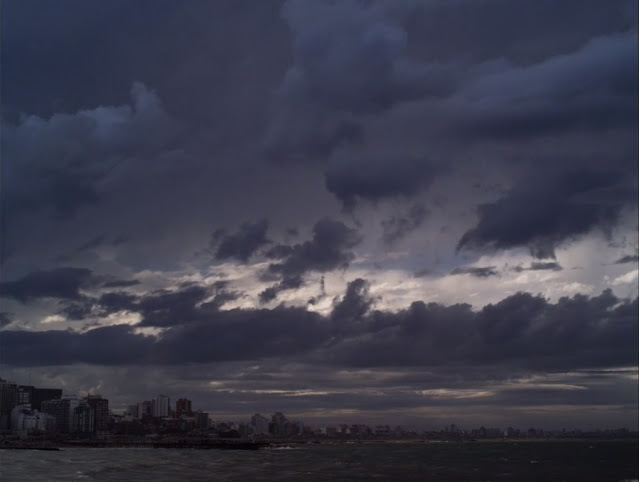
AZUL EL MAR (2019/Sabrina MORENO/Argentina) The sea is not blue. The sea has no colour. It only appears to be blue because of the reflection of the blue sky. This overture statement puts into question the reality our eyes cannot see. The sea is blue in our eyes, but they are deceived by the laws of physics ; in fact the water is transparent. This is a conundrum that will distract our mind while we watch Azul el mar (titled An Ocean Blue in English).   In Mar Del Plata, a perfect middle class family of 6, with 4 children (2 boys, 2 daughters), is taking a vacation trip to the ocean. This is the 90ies because there is no cellphones, children listen to a cassette player, play Simon, and take argentic pictures with an old reflex camera… As the days at the beach unfold, we grow wary of the realism of images. Everything seems normal until the montage goes distorted, deconstructing the pretty memories of this trip into a meticulous introspection. Flashback, daydreaming, fantasy, altern...

Lumière, Warhol, Slow Cinema, Documentary Aesthetics (Craig Fischer)

Image
    English 3175 (video 5) Slow Cinema (Craig Fischer) 26 Sept. 2020 (13'51") Craig Fischer is teaching at the Appalachian State University (Department of English) North Carolina, USA Class : English 3175 Studies in Genre, Issues in Documentary, video presenttion #5 Related read on Unspoken Cinema : Louis Lumière (Rohmer, Renoir, Langlois)