Posts

Showing posts with the label silence

Cinema as contemplation: medieval realism and spiritual silence in Ida (Sanjay Surin)

Latest addition to the Library page at Unspoken Cinema: "This article reinterprets Paweł Pawlikowski’s Ida (2013) as a form of mediated religious communication rooted in the theological and cultural tradition of medieval realism. Drawing on the ideas of Aquinas, Anselm, and Pseudo-Dionysius, it suggests that the film embodies a contemplative mode where truth, goodness, and beauty are regarded as ontological realities rather than subjective ideas. Through silence, stillness, vertical framing, and temporal restraint, Ida conveys a Catholic cultural imaginary that operates beneath explicit doctrine, influencing perception, memory, and moral values. Its formal austerity echoes apophatic theology and monastic practices such as lectio divina, serving as a non-discursive form of Catholic values. By embedding Holocaust trauma within spaces of ritual silence and architectural simplicity, Ida presents memory not as a narrative endpoint but as a mediated act of endurance. The film depicts c...

The Role of Water in Tsai Ming-liang's "The Hole" (CinemaBlog)

Image
  The Role of Water in Tsai Ming-liang's "The Hole" (1998) (YouTube) 5' (CinemaBlog) 30 Jan 2021  "Here, I take a deep dive into the role played by the motif of water in Tsai-Ming-liang's "The Hole" (1998)."

Les hautes solitudes (Philippe GARREL)

Image
  Les hautes solitudes (Philippe Garrel) | Film complet | ARTE Cinema (YouTube) 1h19'37" (ARTE Cinema) 1st July 2026 "Un film disponible jusqu'au 30/09/2026 "L'idée, c'était de faire des chutes d'un film qui n'existerait pas avec une star, Jean Seberg. Alors, j'ai conçu Les Hautes Solitudes comme quelque chose de très brut sur son visage" (Phillipe Garrel) Un visage hébété de femme, entre veille et sommeil (celui de la chanteuse Nico, alors compagne de Philippe Garrel) se laisse contempler quelques minutes, puis disparaît. Dans la pénombre d'un appartement, Laurent Terzieff, cheveux en bataille, accueille et étreint une jeune femme (Tina Aumont), comme lui d'une beauté et d'une jeunesse saisissantes. Dans une chambre (du même appartement, d'un autre ?), en plein jour, Jean Seberg, vêtue d'une sage chemise de nuit, semble lutter contre les vestiges d'un rêve angoissant. En contraste étrange avec l'intimité très ...

Interview with Abdul Rahman (8th Street)

Image
In a region where cinema is measured in song sequences, choreographed fight scenes, and the explosive first-weekend box office of a Rajinikanth release, Abdul Rahman makes films in which very little happens, and that very little is everything. A filmmaker, writer, and cultural organiser based in Tamil Nadu, Rahman occupies a position that is as rare as it is precarious: that of a contemplative filmmaker working entirely outside the logic — commercial, narrative, sensory (also known as “masala cinema”)  — of Kollywood, the Chennai industry that dominates not only Tamil cinema but the cultural imagination of over 80 million people. Where Kollywood offers spectacle, Rahman offers stillness. Where it provides resolution, he leaves space. Where it speaks loudly and continuously, he chooses, with conviction, to fall silent. A decade ago he founded Missed Movies, a project of what Tamil audiences have been systematically denied, or have systematically looked away from. More recently, alo...

Les Grandes Marées du Mont-Saint-Michel (France TV) Slow TV

Image
"Vivez les grandes marées du Mont Saint-Michel en Slow TV. Immersion totale et continue 24/7 sur france.tv : 10 caméras dont un drone et une caméra immergée. Spectacle naturel unique." "Un dispositif technique inédit à suivre en direct et en continu sur france.tv Du lundi 3 novembre à 7h30 au lever du soleil jusqu'au dimanche 9 novembre à 18h00 au coucher du soleil, pendant 155 heures au total, 9 caméras, 1 caméra immergée et 1 drone seront déployés autour du site majestueux du Mont-Saint-Michel, qui deviendra sous nos yeux, une île, à la faveur des plus hauts coefficients de marée de l'année. Ce dispositif permettra une immersion totale, 24 heures sur 24, sans artifice, autour du spectacle des grandes marées, capturant en temps réel les mouvements de la mer et l’incroyable beauté du site. Ces caméras saisiront la montée et le retrait de la mer, à la lumière du jour comme dans l’obscurité de la nuit, révélant alors une facette méconnue de ce spectacle naturel. El...

Silence and Stillness in Slow Cinema (Yu Yang)

Image
  New addition to the Library page at Unspoken Cinema: "This article examines silence and stillness as central aesthetic strategies in contemporary slow cinema, exploring their capacity to evoke contemplation, resist narrative acceleration, and offer alternative temporal experiences in an era of media saturation. Drawing on Paul Schrader’s theory of transcendental style, with its progression from everyday realism to decisive stasis (2018), Ira Jaffe’s conceptualization of slow movies as an existential counter to the spectacle-driven “cinema of action” through curtailed motion and spatiotemporal vacancy (2014), and Tiago de Luca and Nuno Barradas Jorge’s plural, global framing of slow cinema’s challenge to instrumentalized time (2016), the study employs a transcultural comparative approach. Through the interpretive lens of Emersonian Transcendentalism, American filmmakers Terrence Malick, Paul Schrader, and Kelly Reichardt deploy silence as a site of individual spiritual trial, et...

The Eloquence of Silence (Tanya Shilina-Conte)

Latest addition to the Library page at Unspoken Cinema: "This article advances mutism as a creative mode and conceptual tool to treat silence in cinema. Whereas mutism can be a productive concept for the study of auditory and visual absence in a broader theoretical framework, my focus here is on the silence of film characters. Drawing on correspondences between the critical and the clinical in Gilles Deleuze’s writing, I argue that adopting mutism as a tool of film-philosophy permits us to supersede traditional film analysis and examine silence not as an interpretive condition at the level of the plot but as a critical-clinical mode of experimentation related to the symptomatology of life. After presenting a brief clinical history of “elective” and “selective” mutism, I then draw on the suppressed understanding of “elective mutism”. I demonstrate that “elective mutism”, which might appear to be a negative and powerless disorder in its clinical presentation, transforms itself into...

Slow Films and Life (Liminal Movie Project)

Image
  What Slow Films Teach Us About Life (YouTube) 4'17" (Liminal Movie Project) 26 Oct 2025 "In a world of speed and distraction, slow cinema dares to take its time, to let life unfurl at its natural rhythm. From Tarkovsky’s long takes to Chantal Akerman’s stasis, from Béla Tarr’s endless rain to Wong Kar-wai’s yearning pauses — these directors are asking us not to see time pass but to feel it unfold. This essay examines how slow cinema transforms silence into emotion, stasis into animation, boredom into revelation. This outburst isn’t about story — it’s about presence. About the bits between the bits that give life its cinematic quality. If you’ve ever been told that “nothing happens” in a movie, this video is for you."

Movies need to shut up (Accented Cinema) video essay

Image
  Movies Need to Shut Up | Video Essay (youtube) 15'41" (Accented Cinema) 15 August 2025

Deep sea contemplative webcast (Schmidt Ocean)

Image
 In Argentina, since July 2025 and until August the 10th, Schmidt Ocean is casting live its deep sea exploration of the underwater canyon of Mar del Plata, 4000 meters under the surface, off the coast of Buenos Aires. These live streaming on their YouTube channel  for hours on end, have been captivating the Argentine audience, with over a million views per video, commented in Spanish. It reminds of the Slow TV in Norway, or the Great Moose Migration in Sweden.

Ma: Contemplative Editing With Zen Aesthetics (1)

Image
Claude Sonnet 4.0: Contemplative cinema editing employs Zen aesthetic principles to create profound temporal experiences through mindful post-production practices. By integrating meaningful intervals, subjective duration, organic rhythm, purposeful separation, and cyclical imperfection, editors craft viewing experiences that mirror meditative awareness and honor the authentic rhythms of consciousness and perception. 間 MA Meaningful gap or interval Ma, literally meaning "gap" or "pause" in Japanese, embodies the principle that emptiness contains infinite potential for meaning. Unlike Western conceptions of void as absence or negation, Ma celebrates negative space and temporal intervals as equally significant to the elements themselves. In traditional Japanese arts, from flower arrangement to architecture, Ma manifests as the deliberate cultivation of emptiness that allows the mind to complete what is left unsaid or unshown. This concept fundamentally challenges the W...

Zen Concepts in Contemplative Performance (3): Seijaku

Image
  Claude Sonnet 4.0: The intersection of Japanese Zen aesthetics and contemplative cinema reveals profound possibilities for performance that transcend conventional Western acting methodologies. Four essential concepts operate within a complementary theoretical framework: Danshari functions as a foundational methodology for conscious elimination, Iki and Seijaku work as experiential principles governing refined presence, while Yuugen represents the atmospheric mystery that emerges from their synthesis. Together, they create a triadic model progressing from methodological preparation through embodied execution to perceptual reception, challenging performers to locate truth through restraint rather than demonstration and essential simplicity rather than elaborate character construction. 静寂 SEIJAKU Tranquil Stillness Seijaku embodies the profound quietude that emerges when external agitation ceases and inner peace naturally arises, representing far more than mere absence of sound...

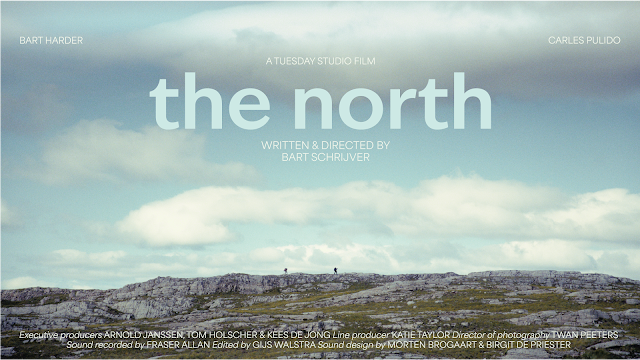
Feet on a relentless path, headspace in a cloud (film review: The North)

Image
The North (2025/Bart Schrijver/Netherlands) The highlands, right in between the clouds and the mountains. Two friends, and solitude all along the way… There was only one goal: reaching the northernmost cape of Scotland from Glasgow, 600 km on foot through the rough terrain, barren or wet wilderness, during extreme atmospheric conditions. Was it a dare, a bucket list or a dream? Chris (Bart Harder) and Lluis (Carles Pulido), former roommates, decided to set apart 30 days from their busy lives and accomplish this adventure together. We don’t know who they are, where they come from, what they want to become… but we’ll discover it, along with them, on the way to Cape Wrath. After a blind phone conversation from the past (as if recorded on an answering machine) of two students planning a farewell party, like a usual “Tuesday night” of drinking at the pub, the film cleverly flashes forward right away to a decade later. All we know about them through this phone call overture is that they use...

Zen Aesthetics through Contemplative Spectatorship (8) Mu & Bi

Image
    Claude Sonnet 3.7:  Japanese aesthetic principles derived from Zen tradition offer a powerful lens for understanding contemplative cinema across cultures. This series examines ten concepts forming a progression from initial receptivity toward deeper awareness—revealing how contemplative films create spaces that transcend narrative efficiency. These aesthetic principles don't merely describe techniques but constitute an entire epistemology of viewing where cinema becomes a meditative practice, enabling access to dimensions of experience often overlooked in conventional spectatorship.     無  Mu &  微   Bi Nothingness and Subtle Profundity Mu and Bi represent perhaps the most philosophically profound and aesthetically sophisticated concepts in Japanese thought, articulating complementary dimensions of experience that conventional Western metaphysics has struggled to adequately conceptualize. Mu transcends simplistic understanding as mere absen...

Zen Aesthetics through Contemplative Spectatorship (6) Ishin-Denshin

Image
  Claude Sonnet 3.7:  Japanese aesthetic principles derived from Zen tradition offer a powerful lens for understanding contemplative cinema across cultures. This series examines ten concepts forming a progression from initial receptivity toward deeper awareness—revealing how contemplative films create spaces that transcend narrative efficiency. These aesthetic principles don't merely describe techniques but constitute an entire epistemology of viewing where cinema becomes a meditative practice, enabling access to dimensions of experience often overlooked in conventional spectatorship.   以心伝心  Ishin-Denshin Direct Transmission Beyond Words Ishin-Denshin represents one of the most profound and elusive concepts in Japanese aesthetic and spiritual tradition, describing a mode of communication that transcends conventional linguistic and conceptual boundaries. The term itself—literally "from mind to mind" or "heart-to-heart transmission"—emerged from Zen Buddhist cont...

Le mutisme au cinéma (Milène Chave)

 Dernière addition à la page Bibliothèque sur Unspoken Cinema : "Avant même l’arrivée du parlant, le cinéma fut colonisé par le verbe : la parole fut dès lors instrument du discours, guide du spectateur. [..] Le sujet du silence nous a toujours fasciné car il touche à l’indicible, au non-dit. L’exclusion des mots qui, s’ils étaient prononcés, en réduiraient leurs sens, engendre une polyphonie du (des) sens en même temps qu’un pouvoir émotionnel fort. Elle est une capacité d’expression du langage très utilisée au cinéma. Dans cet univers d’absence de voix, le mutisme nous intéresse particulièrement : il nous renvoie à nos moments de doute, à ces instants où il est trop dur ou difficile de parler, où les mots ne semblent pas pouvoir exprimer ce qui est réellement ressenti. La richesse de ses significations et de ses utilisations permet au cinéma de mener le spectateur vers un travail d’intériorisation, dans un monde plus subjectif que pra...

Zen Aesthetics through Contemplative Spectatorship (3) Chinmoku

Image
Claude Sonnet 3.7:  Japanese aesthetic principles derived from Zen tradition offer a powerful lens for understanding contemplative cinema across cultures. This series examines ten concepts forming a progression from initial receptivity toward deeper awareness—revealing how contemplative films create spaces that transcend narrative efficiency. These aesthetic principles don't merely describe techniques but constitute an entire epistemology of viewing where cinema becomes a meditative practice, enabling access to dimensions of experience often overlooked in conventional spectatorship.   沈黙 Chinmoku The Eloquence of Cinematic Silence Chinmoku, translated as silence or profound reticence, constitutes one of the most sophisticated concepts in Japanese aesthetics, extending far beyond mere absence of sound to embody a positive philosophical principle with ontological significance. Within Zen Buddhist tradition, silence represents not emptiness but plenitude—a fullness of potential m...