Posts

Showing posts with the label extensive tableaux

Le Slow Cinéma (Méline)

Image
  Le Slow Cinéma (YouTube) 4'33" (Méline) 25 mai 2025 Par Méline Crampon & Jad Belmaachi « Le cinéma substitue à notre regard un monde qui s’accorde à nos désirs » - André Bazin

Attraits de Zuchuat (Corentin Lê)

Revue de presse du livre d'Olivier Zuchuat : Attraits de la durée (2025) dans la nouvelle revue en ligne critique et décoloniale, Emitaï : "Notre quiétude n’est que passagère Pour Olivier Zuchuat, si tous ces cinéastes s’épanouissent autant dans les interstices marginalisées du monde moderne, allant jusqu’à inventer des formes filmiques auprès des plus démuni·es, c’est entre autres car le cinéma, comme l’écrivait Jacques Rancière à propos de l’œuvre de Pedro Costa, « ne peut plus être l’art qui simplement rend aux humbles la richesse sensible de leur monde, [mais doit] consentir à n’être que la surface où cherche à se chiffrer en figures nouvelles l’expérience de ceux qui ont été relégués à la marge des circulations économiques et des trajectoires sociales ». [..]" Corentin Lê ; Attraits de la durée ; 3 avril 2026 in Emitaï Voir aussi sur Unspoken Cinema : Entretien Olivier Zuchuat (Microciné) Plans perdurant et points de montage (Olivier Zuchuat) Retrancher le monde. ...

Entretien Olivier Zuchuat (Microciné)

Image
  Regarder tenir feat. Olivier Zuchuat (YouTube) 40'19" (Microciné Revue de Cinéma et de Télévision) 25 mars 2026 "À l’occasion de la parution de Attraits de la durée, Olivier Zuchuat revient sur un travail qui, sous des allures théoriques, reste profondément lié à une pratique du cinéma. Il ne cherche pas à redéfinir frontalement ce qu’est un film, mais à déplacer légèrement le point d’attention, à partir d’un élément simple — le plan — pour en éprouver les conséquences. L’idée, au fond, tient en peu de mots : le montage ne serait pas seulement ce qui relie les plans entre eux, mais ce qui s’opère déjà à l’intérieur du plan lui-même, dans sa durée, dans ses déplacements, dans la manière dont il organise l’espace et le temps. À partir de là, tout se reconfigure. Ce que l’on croyait stable — découpage, rythme, progression — devient plus incertain, plus diffus, comme si le film se mettait à respirer autrement. Certains exemples rendent cela immédiatement sensible. Dans les...

Tableau Vivants = Figure of Return (Ágnes Pethő)

Latest addition to the Library page at Unspoken Cinema: "The paper analyses the re-conceptualization of the intermedial trope of the tableau vivant in recent East European cinema through several examples from Hungarian and Russian films directed by György Pálfi, Kornél Mundruczó, Benedek Fliegauf, Béla Tarr, and Andrei Zvyagintsev. The tableau vivant in these films is not conceived primarily as an embodiment of a painting, the introduction of “the real into the image” (as Brigitte Peucker described), instead it appears more like the objectification of bodies as images, and something that we can associate with what Mario Perniola considers the “sex appeal of the inorganic” or “the Egyptian moment in art.” As such, the tableau becomes a powerful agent in generating metanarratives, offering a blueprint for a “big picture,” a comprehensive vision of the world (reinforced by recurring mythological themes like the genesis or the end of the world, the loss of Paradise, etc.). We may con...

Hamvas Béla út 11. (Janos KIS)

Image
Hamvas Béla út 11. (YouTube) 55'36" (Kis ZenFilms) 15 Jan 2026 * * * Hamvas Béla út 11. / Hamvas Béla street 11. (2025/Janos KIS/Hungary) a review by Benoit Rouilly Living the weight of an hour, a man takes us through the mundanity of unfettered existence. How much does an hour of human life weigh? Eight moments, eight plans-séquence tell the tale of a daily routine. The slightest gesture is well-rehearsed by life-long habits, not even conscious or calculated. A prosaic choreography of solitude takes place before our eyes. Not a single word is uttered as the unnamed protagonist undertakes repetitive chores. This individual is all of us when nobody’s watching. The muscle memory of his alienation draws lonely circles throughout his apartment. It is as much a chronicle of his life than it is a document of his living space. A modest home on the 13th floor in a Budapest social project from the 60ies. A socialist-era prefab apartment block. The washed-out facade is a vertiginous p...

Sinité du plan-séquence dans le cinéma chinois (Félicien Rioufol)

Dernière ajout à la page Bibliothèque (Library) sur Unspoken Cinema : "Il y aurait une sinité du plan-séquence chinois, une profonde interconnexion entre les traditions artistiques et philosophiques de la Chine et cette pratique cinématographique. Enraciné dans des concepts tels que le wuwei erwei et inspiré par l'esthétique du rouleau horizontal et du lavis. Le plan-séquence depuis ses débuts dans le cinéma chinois semble incarner une vision chinoise du temps et de l'espace. [..]" "On peut aisément avancer que le plan-séquence dans le cinéma chinois est le fruit d’une fraternité avec l’international slow cinema représenté par des réalisateurs asiatiques comme Apichatpong Weerasethakul ou Lav Diaz. Ainsi ce n’est pas une filiation avec un passé traditionnel mandarin qui expliquerait cette surprésence du plan-séquence dans le cinéma chinois de la sixième génération mais une connexion avec une mouvance actuel dans le cinéma asiatique. Lorsque l’on étudie le plan-...

Slow Burn (Eye Filmmuseum)

"[..] For proponents of the slow-cinema idea, an action should take just as long as it needs; a car approaching from a long distance in a broad landscape doesn’t have to appear in front of the camera in close-up within two seconds (see Ceylan’s Once Upon a Time in Anatolia, for example). Carrying out domestic chores can be filmed in real time; cooking a potato takes place according to the laws of physics, not those of cinematography (as in, for example, Chantal Akerman’s Jeanne Dielman). [..]" Thijs Havens (Eye Filmmuseum; Netherlands) Special screening programme (part of the Nuri Bilge Ceylan retrospective, Inner Landscape , 18 Jan-1 Jun 2025): Koza (Nuri Bilge Ceylan, Turkey 1995, 20') Prologús (Béla Tarr, Hungary 2004, 5')  La chambre (Chantal Akerman, Belgium 1972, 11') Szél (Marcell Iványi, Hungary 1996, 6')  The Night (Tsai Ming-liang, Taiwan 2021, 19')

More like this (1) Gerry

Image
 Watch More Like This Film: Gerry (2002/Van Sant) keywords = Desert + Walking + Mutism (*) Non Contemplative Film More like it: Freedom (2000/Bartas) More like it: Honor of the Knights (2006/Serra) More lonely: Le moindre geste (1971/Deligny) More slowed down: Walker series (2012-2024/Tsai) More islandish: The Red Turtle (2016/Dudok De Wit) More desert: Birdsong  (2008/Serra) More forest: Los Muertos (2003/Alonso) More snow: Essential Killing (2010/Skolimowski) More epic: Satantango (1994/Tarr) More Kabuki: Dolls (2002/Kitano) *More Amerindian: Dead Man (1995/Jarmusch) *More verbalisation: Stalker (1979/Tarkovsky) *More vagabond: Sans toit ni loi (1985/Varda) More engines: The Brown Bunny (2002/Gallo) Find more Contemplative films at Unspoken Cinema: CCC Recommendations

Candlelight Journaling (Sean Alan Stone)

Image
  Candlelight Journaling: A Meditative Minimalist Slow Cinema (YouTube) 14'34" (Sean Alan Stone) 9 dec 2024

Empire at 60 (Warhol)

Image
Empire (1964/Warhol/USA) Andy Warhol's 8h long epic contemplative (stasis) documentary has 60 years old! Filmed 25-26 July 1964, from 8:06 pm to 2:42 am, at the offices of the Rockefeller Foundation on the 41st floor of the Time-Life Building (16 blocks from the Empire State Building) by Andy Warhol and Jonas Mekas, on 1,200 foot of 16mm film rolls. The Empire State Building will celebrate the 60th anniversary of Andy Warhol’s black-and-white silent film, “Empire,” with an exclusive screening on the building’s 80th Floor, in collaboration with The Museum of Modern Art and the Andy Warhol Museum. (screened between the 25 and 28 july 2024) "To see time go by..." is Warhol's answer to why this experimental project?

Contemplative Core & Tectonic Plates

Image
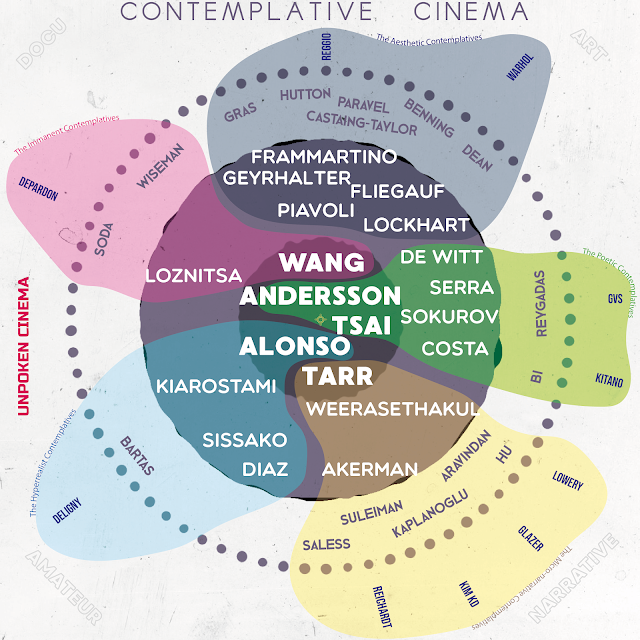
The core figures of Contemplative Cinema could be summed up by the names: WANG Bing, Roy ANDERSSON, TSAI Ming-liang, Lisandro ALONSO, and Béla TARR, for being consistently, profoundly, and magnificently contemplative... (See Iconic Directors of Contemplative Cinema ) Out of the minimalist centre radiate trustworthy rings of authentic contemplatives, up to the far reach of more conventional edges, maybe more "slow" than "contemplative”, but still minimalist. However, under this uniting banner of “Contemplative Cinema” surges the distinctive rifts between the tectonic plates of more cohesive sub-divisions… because it’s crucial to extract their diversity from their resemblance, their personality from their unity. From this widespread of satellites emerges 5 more stylistically coherent sub-families sorted by affinity tending towards "Art" (Art Gallery and Minimalist Formalism), "Narrative" (but still Minimalist), "Amateur" (Minimalist Hyperreali...

CCC FAQ #6 : What are the main features of Contemplative Cinema?

Image
Contemporary Contemplative Cinema Frequently Asked Questions #6 :  What are the main features of Contemplative Cinema ?   We could designate five aesthetic characteristics departing Contemplative Cinema from its Modernist precursors and its minimalist contemporaries (also known under the broader term of « Slow Cinema ») : 1. Exteriority First and foremost, Contemplative Cinema takes a step back and aside, to observe the protagonists and the universe from outside. The non-intrusive camera plants itself in a corner and looks on the whereabouts of people who happen to pass by. The framing of this reality is all-embrassing and captures more than is necessary to provide a solid context to each shot. The spectator scrutinizes the outer shells of mutic faces and gazes over what could have been, ruminates blindingly on what once was, contemplates lengthily on what might happen next… 2. Hyperrealism Real-life is the template. The screen is a mirror. Away from the artifice of pure ficti...