Posts

Showing posts with the label Tarr Béla

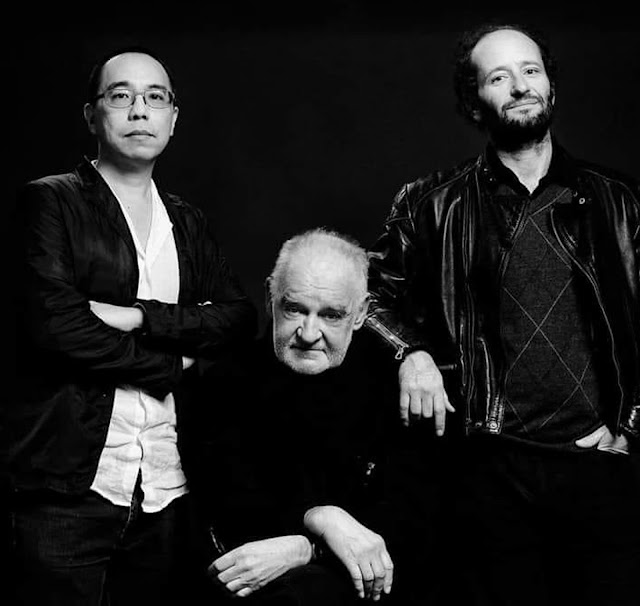
Tarr, Apichtapong, Reygadas in discussion (Sarajevo Film Academy)

Image
  (Left to right: Apichatpong Weerasethakul, Béla Tarr, Carlos Reygadas) Watch the discussion between Apichatpong Weerasethakul, Carlos Reygadas and Béla Tarr (The Film Stage, Sarajevo Film Academy, 12 Dec 2016) 40' x2

My 2022 Top20 CCC Canon

Expanded to 20 spots, since my last Top10 Canon in 2012 , because the population of CCC has grown "exponentially", reaching over 350 films (as registered in my CCC Recommendations )... here is an updated Contemporary Contemplative Cinema Canon, based on my viewing experience and my own criteria, featuring its greatest aesthetic achievements to date :  My Top20 CCC Canon  (2022 Updated) Sátántangó  (1994/TARR Béla Tarr/Hungary) Jeanne Dielman, 23 quai du Commerce 1080 Bruxelles  (1975/Chantal AKERMAN/Belgium) Tie Xi Qu: West of the Tracks  (2003/WANG Bing/China) The Turin Horse   (2011/TARR Béla/Hungary) Le Moindre Geste  (1971/DELIGNY/MANENTI/FR) I Don't Want to Sleep Alone  (2006/TSAI/Taiwan)  Los Muertos  (2004/ALONSO/Argentina)  Leviathan  (2012/CASTAING-TAYLOR, PARAVEL/FR-USA-UK) DOC Blissfully Yours   (2002/WEERASETHAKUL/Thailand) An Elephant Sitting Still  (2018/HU Bo...

CCC 1967-2020 by auteur

Image
Films made by 22 recurrent Contemporary Contemplative Cinema figureheads since 1967 [ Google sheet ] It's time to update the CCC timeline 2008 , I hastly put together 12 years ago, at the origin of this blog. I had omitted back then Peter Hutton, Franco Piavoli, Tacita Dean, Elia Suleiman, Nikolaus Geyrhalter, Sergei Loznitsa & Kazuhiro Soda, who I didn't know, as well as most of James Benning's output. But a few also don't make the cut this time around (Omirbaev, Kore-eda, Costa, Ceylan, JZK, GVS, Martin, Escalante, Serra) for various reasons (too few CCC films, too "speechy"/narrative in comparison to the other main figureheads, but it doesn't mean they are not contemplative, just they are not part of the chosen few CCC role models)... in order to paint a clear picture, more radical, of this new narrative cohort. One thing did change : the year of debut of this narrative mode, now 1967 instead of 1970. In restrospect, we can see clearly now the years...
Fireflies

Fireflies is a print magazine, a beautifully crafted book, published between Berlin and Melbourne by founders Annabel Brady-Brown and Giovanni Marchini Camia: (...) Each issue assembles an international group of writers and visual artists to celebrate the work of two extraordinary filmmakers through personal essays, interviews and creative responses. (...) We print responses to cinema that are personal, daring and that wouldn’t necessarily be found in other film journals­: short fiction, visual art, poetry, memoir, comics, and creative non-fiction that experiments with multiple forms. (...) What is interesting to Unspoken Cinema is the filmmakers they chose, always by pair, are familiar with the list of CCC filmmakers : Issue #1 : Pasolini / Apichatpong Weerasethakul  (out of print) Issue #2 : Kiarostami / Tarr  (out of print) Issue #3 : Claire Denis / Jia Zhangke Issue #4 : Pedro Costa / Ben Rivers Issue #5 : Angela Schanelec / Agnès Varda

Pour un cinéma contemporain soustractif (Antony Fiant)

Image
Pour un cinéma contemporain soustractif Antony Fiant (Juin 2014) extrait PDF  / Site de l'éditeur Résumé : Depuis le début du XXIe siècle, on observe l'apparition régulière de films minimalistes manifestant une réticence marquée envers le scénario, le récit, la parole, la musique et la psychologie. Qu'ils relèvent de la fiction, du documentaire, ou des deux à la fois, les films de quinze cinéastes du monde entier (Lisandro Alonso, Wang Bing, Alain Cavalier, Pedro Costa, Darejan Omirbaev, Béla Tarr, entre autres) sont ici analysés d'un point de vue esthétique et dramaturgique pour mieux mettre en évidence un geste soustractif. Moins d'histoire, moins de dialogues, moins de décors, ces caractéristiques manifestent une belle foi en l'art du cinéma et en sa capacité de suggestion. Cet ouvrage veut réaffirmer les spécificités d’un art de la mise en scène, de l’espace et du temps. Force est de constater la présence dans le cinéma le plus contemporain (i...

Left Field Cinema Podcast (Mike Dawson)

Left Field Cinema was first released in November 2007, written and presented by Mike Dawson. The show has two main purposes; the first is to examine cinema in relative terms, tackling main stream cinema from alternative perspectives, applying varying theories to popular films and hopefully discussing them with a fresh point of view. The second purpose is to unearth more obscure films from world cinema and the independent scene, films that perhaps you've never heard of but are worthy of your attention. Left Field Cinema Podcast  (Mike Dawson) Selected episodes relating to CCC films : World Cinema Masterpiece: Werckmeister Harmonies  [ MP3 ] 26'52" An extended examination of Bela Tarr's modern masterpiece about the boundaries between civility and barbarism. Also featuring a look back at the first eight feature films of Tarr's career. Contemporary Obscurity: Satantango  [ MP3 ] (missing MP3, read the written review instead) Bela Tarr's seven and a hal...

Comparative Cinematics : Jancsó & Tarr (Kevin B. Lee)

Image
Keyframe: Mapping the Long Take (Tarr Béla, Jancsó Miklós) 5'49" By Kevin B. Lee from Fandor [..] Comparing this one shot from The Turin Horse (2011) with the one that we just watched [ The Red and The White ], you can see how Bela Tarr‘s use of the long take both incorporates and rejects different elements of Jancso’s camerawork. Here the camera is less active and elaborate, and the staging is less busy. Instead, there’s a greater emphasis on physicality. [..] The moments where the camera is static let us focus on the material, tactile qualities of the visuals: stone, wood and dirt. [..] Bela Tarr uses [long take] to convey the palpable sensations of a lived experience, one of harsh, grueling exertion. Like the Jancso scene, there’s a pendulum-like rhythm to the camera movement as it moves back and both between two poles of activity. Like Jancso, though to a lesser degree, Tarr is able to use off-screen space to economize activity: Notice how by the time the camera r...

Tarr's Film Academy 2013

Tarr Béla : "While there are more and more images everywhere around us, paradoxically, we perceive the increasing devaluation of this beautiful language every day. It is in this context that we are seeking to demonstrate, emphatically and convincingly, the importance of visual culture and the dignity of the image to the coming generation of filmmakers. Our aspiration is to educate mature filmmakers who think responsibly, with the spirit of humanism, artists who have an individual outlook, an individual form of expression and who use their creative powers in the defence of the dignity of man. Sarajevo offers the right home for this program as a multicultural city that is young and vibrant." * * * Hungarian arthouse director Bela Tarr is opening a PhD-level filmmaking academy in Sarajevo, Bosnia and Herzegovina. The Film Factory , housed in Sarajevo University's School of Science and Technology , will bring together some of the world's top directors to teach a...

My CCC Top10 Canon

I usually refuse to compare CCC films on a merit basis, since this blog is dedicated to the study of the aesthetic, of this narrative mode, not to fuel the craving of detractors for reasons to dismiss "bad" CCC films (because they don't know how to find CCC-specific reasons to blame a film for failing to achieve its goal). But in the context of Sight & Sound 2012 Top10 canon, let's also establish a referential standard for the quintessence of CCC, the greatest achievements of this particular aesthetic, which is now a little over 40 years old. My (partial and non-consensual) Top10 ballot of the greatest aesthetic achievements in Contemporary Contemplative Cinema since 1970 : Sátántangó (1994/TARR Béla Tarr/Hungary) Mother and Son (1997/SOKUROV/Russia)  Jeanne Dielman, 23 quai du Commerce 1080 Bruxelles  (1975/Chantal AKERMAN/Belgium) The Turin Horse  (2011/TARR Béla/Hungary) Tie Xi Qu: West of the Tracks  (2003/WANG Bing/China) I don't want to ...

Tarr Béla's film company closes down

Bela Tarr to shutter production company. Helmer laments 'crisis' in art cinema  (John Nadler;  Variety ; 24 May 2012) BUDAPEST -- Hungarian auteur Bela Tarr has decided to shutter his production house T.T. Filmmuhely at the end of this month. According to Tarr, the demise of the shingle, which produced pics like Tarr's " The Man from London " and " The Turin Horse ," reflects the crisis besetting art cinema in Hungary and Central and Eastern Europe. "We have no choice but to acknowledge that despite our efforts our situation has become untenable," Tarr and partner Gabor Teni said in a joint statement. Tarr has been a critic of reforms to Hungary's film-funding system, which he says discourages art film production in favor of mainstream entertainment pics. In February, Tarr helped organize a film festival to protest against Hungary's new film funding system. But proponents of the new system, devised by Hungarian-born Hollywood pr...

As Slow As Possible (AV Festival 2012)

Image
AV Festival 12 : As Slow As Possible  International Festival of Art, Technology, Music and Film Newcastle, Gateshead, Middlesbrough and Sunderland (UK) 1st - 31st March 2012 [ PDF ] website In the run-up to London 2012 with its motto of “Faster, Higher, Stronger” we propose an alternative slower pace and relaxed rhythm to counter the accelerated speed of today. Titled after ASLSP (As SLow aS Possible) by pioneering artist John Cage, the theme explores how artists have stretched, measured and marked the passage of time. Some works last the full 31 days, others are infinite in duration or move imperceptibly slowly: 14 seconds become 31 minutes, one hour becomes 24, and we can all dream together in a 12-hour sleep concert Century of Birthing (2011/Lav Diaz/The Philippines) Slow Cinema is a series of over thirty landmark films from leading international filmmakers, focused around slowness, and interwoven through AV Festival 12....

A primitive language (Tarr)

Tarr Béla : "It's very difficult to talk about what we really think to be a film. The question really is what is film for? It's a long time since we came to the conclusion that film is not about telling a story. It's function is really something very different, something else. So we can understand everyday life. And that somehow we can understand human nature, why we are like we are. We believe that apart from the main protagonists in the film there are other protagonists: scenery, the weather, the time and locations have their faces and they are important, they play an important role in the story. From the very beginning the way we handled was probably different from other films. first of all because we cut and edited the film differently, most films are edited in the way pieces of information are edited, we didn't do it that way. We are paying more attention to the internal psychological processes. And we concentrate on the personal existence and the personal ...

Masterclass par Tarr Béla

Master Class avec Bela Tarr 3 décembre 2011 ( centrepompidou ) 1h47' L'expression « film-monde », toute galvaudée qu'elle soit, est la plus à même de rendre compte du cinéma de Béla Tarr. Car ses films se voient moins qu'ils ne s'habitent et ne se vivent. Chez Béla Tarr, j'ai suivi un troupeau de vaches qui sortaient de l'étable, je suis entré dans une baleine qui me fixait d'un œil mort. J'ai marché, longuement, j'ai parcouru des visages comme si c'étaient des paysages, et inversement. J'ai eu froid, j'ai été mouillé jusqu'à l'os par des pluies diluviennes. J'ai senti la terre et je m'y suis enfoncé. Je me suis réfugié dans des cafés, j'y ai dansé et bu, et au Titanik Bar, j'ai senti la catastrophe qui vient. En voyant ailleurs un ballet d'ivrognes qui tournaient sur eux-mêmes en suivant le mouvement des planètes, j'ai touché du doigt que toute solitude, toute misère et tout désarroi sont d'ord...

Rapports préfabriqués (présentation de l'auteur)

Rapports préfabriqués de Bela Tarr 5 décembre 2011 ( centrepompidou ) 43'48" « Nous sommes parvenus à la conclusion qu'un film ne raconte pas d'histoire. Sa fonction est tout à fait autre. Se rapprocher des gens, comprendre la vie quotidienne. Et ce faisant, comprendre la nature humaine et pourquoi nous sommes comme nous sommes. Comment nous commettons des péchés, comment nous nous trahissons les uns les autres et ce qui nous meut. » Béla Tarr, interviewé par Jonathan Romney, in Béla Tarr , Budapest, Magyar Filmunió, 2001. Voir aussi: Rétrospective Tarr Béla (Paris) LINKS page Tarr Béla Eléments Tarr (Arte) Unspoken Journal - Tarr Béla (2009) [offline]

Damnation (présentation de l'auteur)

Damnation de Bela Tarr 4 décembre 2011  ( centrepompidou ) 4'16" « Rien n'est anecdotique dans cette évocation pourtant très quotidienne d'une petite ville, d'un homme dévoré de remords et de désir. Avec un sens profond des correspondances, le cinéaste relie les paysages corrodés, les sonorités rouillées, les visages clos sur leurs secrets, les vertiges intimes et les réjouissances populaires. Un défilé de bennes grinçantes, un chien errant dans la nuit, une pile de verres sur l'étagère du bar, une chanson à serrer le cœur, un mur suintant de pluie, chaque détail existe avec une précision intense, et en même temps tous se répondent et se fondent dans une prenante atmosphère de film noir. » Marie-Noëlle Tranchant, Le Figaro , 20 avril 2005. Voir aussi : Rétrospective Tarr Béla (Paris) LINKS page Tarr Béla Eléments Tarr (Arte) Unspoken Journal - Tarr Béla  (2009) [offline]

Le nid familial (présentation de l'auteur)

Le Nid familial de Béla Tarr 4 décembre 2011 ( centrepompidou ) 33'44" « C'est une histoire vraie. Elle n'est pas arrivée aux personnages de notre film, mais elle aurait pu leur arriver à eux aussi » : c'est par ces mots que débute le premier film de Béla Tarr. Laci, fils ainé de sa famille, rentre chez ses parents après son service militaire pour y retrouver sa femme Irén et leur fille. La famille élargie partage un appartement minuscule, situation qui semble vouer toute relation humaine à l'explosion. Réalisé à partir d'improvisations, le film scrute les visages de ses personnages pour livrer un tableau critique de la société hongroise de la fin des années 1970. « La façon dont Béla Tarr, comme Fassbinder, décrit l'environnement est à la fois naturaliste et théâtrale. Ses personnages sont ordinaires, mais leurs impulsions, leurs passions, leur égoïsme et leur souffrance les rendent exceptionnels. Les deux cinéastes condensent la teneur dramati...

Conférence Tarr (Rancière)

Image
Jacques Rancière, Béla Tarr, le temps d'après  ( centrepompidou ) 7 décembre 2011 : Quelques réflections sur la poétique des films de Béla Tarr conférence de Jacques Rancière ( video 1h17' ) Grand penseur de l'émancipation, le philosophe Jacques Rancière construit une réflexion où s'entremêlent politique et esthétique, que celle-ci soit entendue dans le sens d'une relation sensible au monde en général ou à une œuvre d'art en particulier. * * * Ecouter aussi : 30 novembre 2011 : Laurent Goumarre, Jacques Rancière et Tarr Béla ( Le Rendez-Vous ; France Culture) [MP3] 1h  3 décembre 2011 : Michel Ciment et Jacques Rancière, Sylvie Rollet, Kristian Feigelson, András Kovács, Emeric de Lastens ( Projection Privée ; France Culture) [ MP3 ] 1h Bela Tarr. Le temps d'après (Jacques Rancière; 2011) Related: Rétrospective Tarr Béla (Paris)  / Conférence Tarr (Paris) /  LINKS page Tarr Béla Eléments Tarr (Arte) Unspoken Journal - Tarr ...

Table ronde sur le cinéma de Tarr Béla

Table ronde, Bela Tarr  ( centrepompidou ) 17 décembre 2011 : Table ronde avec Kristian Feigelson, András Kovács, Sylvie Rollet, Emeric de Lastens et Jarmo Valkola ( video 1h42' ) Cette table ronde, sous l'égide de l'Institut Hongrois de Paris, se propose d'explorer les aspects multiformes de l'œuvre de Béla Tarr et de questionner ses différents régimes d'écriture filmique * * * Ecouter aussi :  3 décembre 2011 : Michel Ciment et Jacques Rancière, Sylvie Rollet, Kristian Feigelson, András Kovács, Emeric de Lastens ( Projection Privée ; France Culture) [ MP3 ] 1h Voir aussi : Rétrospective Tarr Béla (Paris) LINKS page Tarr Béla Eléments Tarr (Arte) Unspoken Journal - Tarr Béla (2009) [offline]

Rétrospective Tarr Béla (Paris)

Image
Bela Tarr, l'Alchimiste par centrepompidou Si son nom est encore méconnu du grand public, ses films eux ont marqué les esprits de tous ceux qui ont eu la chance de les voir. Le réalisateur Gus Van Sant, l'essayiste Susan Sontag ou encore l'actrice Tilda Swinton ne s'y sont pas trompés : tous considèrent le Hongrois Béla Tarr comme l'un des plus grands cinéastes de son temps. Son dernier film, Le Cheval de Turin , qu'il présente comme le point final de sa carrière, a été projeté en début d'année au festival de Berlin où il a remporté l'Ours d'Argent. Pour ouvrir la rétrospective intégrale de son œuvre au Centre Pompidou, Béla Tarr partage sa vision du cinéma lors d'une « master class » exceptionnelle et présente trois œuvres : Le Nid familial , premier film évoquant les problèmes sociaux de la Hongrie de son époque dans un style presque documentaire ; Damnation , qui aborde la décrépitude morale par des travellings dignes de Tarkovski et Les ...

Slow Parody (Sight&Sound)

"I fell to wondering how Europe's great auteurs would get on should they stray into the world of cunning stunts and spectacular car crashes [..] Béla Tarr remakes Two-lane Blacktop The development process is slow given Tarr's insistence that the existing screenplay (a) has too much dialogue, (b) spends too much time off the highway, and (c) is too short. Progress is slow; producers come and go; and, as a decade goes by, Tarr immerses himself in 1970's American cinema, showing special interest in Five Easy Pieces. Shooting begins with János Derzsi in a Dodge Charger driving very slowly along an empty desert highway with the camera tracking beside him. Chapter two : Derzsi stops at a roadside diner and orders potatoes. The waitress points out that potatoes are served only as part of other dishes. Very slowly, Derzsi begins to work his way Jack Nicholson's "hold the chicken" speech from Five Easy Pieces until potatoes are served - for that, it turns out, ...