Posts

Nasumice / Adrift (2018) Caleb BURDEAU

Image
  NASUMICE (2018/Caleb BURDEAU) OPENING SEQUENCE « We’ve changed ? Hardly, not significantly. The World has changed. I’ve stayed the same : I live in constant change and I know all about you, all that can be known, all but your address, the city you live in, your children, the langage you fill out forms in, where you go in the morning and who you come back to in the evening, that I don’t know but I can guess (I can see it all with frightening clairvoyance). We have not changed. You live unchanged, a witness to changes. And you know almost all about me, all that you need to know. And those of us who didn’t make it ? But how can we talk at all about what they’ve changed into ? It is the world that changed by not being around, we have stayed the same. Far from each other, obsessed with the same world. Small as we are, insignificant. » Poem by Saša Skenderija ( Common Places, 2011) Bosnian-American poet THE CHANCE ENCOUNTER It all...

INTERVIEW with Caleb BURDEAU, auteur of NASUMICE

Image
  Nasumice  (2018) follows around Italy one Bosniac refugee, Elvis, who works as a tourist photographer. He wanders through the streets and meets a strange character, Rodolpho, who invites him home. The TV news report on the siege of Sarajevo. In the wonderful landscape of rural Southern Italy, the two road buddies will share a piece of an existential journey. Nasumice is a minimalist film with sparse music and small dialogues, about the social alienation of two lonely grown men. They just travel throughout some ancestral places made of stones in a barren environement. « Caleb was born in Seattle, USA, to an Irish-American father and a New Zealand mother. After moving to Alaska with his family when he was six weeks old, Caleb grew up traveling continuously between the northern and southern hemispheres, finally settling in Italy with his father and two brothers when he was 15. Before turning to film making in 2009, Caleb had worked as a motorcycle courier, a printer, a ...

What is Slow Cinema? (Francesco Quario)

Image
    What is Slow Cinema? (Francesco Quario) 5 dec 2020 - 24' Related read on Unspoken Cinema : Slow Films Easy Life (Sight&Sound)   The State of Cinema (M. Ciment) Slow Cinema Discussion at To Be (Cont'd) 2014 Slow Cinema Essay & Kaili Blues

KIM Ki-duk (1960-2020)

Image
  김기덕   KIM Ki-duk (1960-2020) Read also on Unspoken Cinema : La révolution du silence (Krishnamurti)

Un très long temps d'exposition (Chloé Galibert-Laîné)

Take a long look at Chloé Galibert-Laîné's video essay, on the Yerevan Biennale website, on long exposure photography (Daguerre), James Benning's stasis films, A Japanese videogame with a mysterious lake, and a poem by her father : A Very Long Exposure Time (2020/Galibert-Laîné) 7' See also :  Flânerie 2.0 (Chloé Galibert-Lainé)

Brume, cailloux et métaphysique (2014/Lisa Matuszak/France)

Brume, cailloux et métaphysique from EMCA Angoulême  "Fog, pebbles and metaphysics" (click link above to watch on Vimeo)

Masterclass de WANG Bing (2018)

Rétrospective et masterclass WANG Bing  à l'Ecole des Haute Etudes de Sciences Sociales  le 31 octobre 2018 Vidéo de la Masterclass (140min) Mandarin + Français avec Stéphane Breton, Emanuèle Coccia Programme complet de la rétrospective "Wang Bing : l'art du regard" Madame Fang Le Fossé L'Homme sans nom  L'Argent du charbon  Traces Related : CCC Masters : WANG Bing WANG Bing (France Culture 2017) WANG Bing & Jaime ROSALES en correspondances (Centre Pompidou, Paris 2014) L'homme sans nom (WANG Bing, Didi-Hubermann) WANG Bing (EIFF) English masterclass WANG on real and fiction  

Slow TV

The World's Most Boring Television... and why it's hilariously addictive (Thomas Hellum) TED talk (18') Related :  Contemplative TV Cruise   Longest slices of life (TV/net marathon-length documentaries)

In Praise of Slowness (Carl Honore) TEDtalk

Image
In Praise of Slowness - Carl Honore - 2005 (19'11") When you feel the need to speed up, slow down - 2014 (20') Pourquoi tout est plus beau quand tout est plus lent ? Collectif Catastrophe - 2017 (5'28") Related : I always liked it slow (Leonard Cohen) Le droit à la paresse (Jorda) La lenteur (Bratu)

HONG Sang-soo's favourite films (2017)

Hong Sang-soo shares his top10 favourite films and you'll be surprised, it's full of contemplative cinema  TheFilmStage (13 Nov 2017)   L'Atalante (1934/Jean VIGO) Barque sortant du port / Boat leaving the port (1897/Louis LUMIERE) Boudu sauvé des eaux / Boudu Saved From Drawing (1942/Jean RENOIR) Early Summer (1951/OZU Yasujiro) Le rayon vert / The Green Ray (1986/Eric Rohmer) Un condamné à mort s'est échappé / A Man Escaped (1956/Robert Bresson) Nanook of the North (1922/FLAHERTY) Nazarin (1959/Luis BUÑUEL) Ordet (1955/DREYER) Young Mister Lincoln (1939/FORD)

CCC 1967-2020 by auteur

Image
Films made by 22 recurrent Contemporary Contemplative Cinema figureheads since 1967 [ Google sheet ] It's time to update the CCC timeline 2008 , I hastly put together 12 years ago, at the origin of this blog. I had omitted back then Peter Hutton, Franco Piavoli, Tacita Dean, Elia Suleiman, Nikolaus Geyrhalter, Sergei Loznitsa & Kazuhiro Soda, who I didn't know, as well as most of James Benning's output. But a few also don't make the cut this time around (Omirbaev, Kore-eda, Costa, Ceylan, JZK, GVS, Martin, Escalante, Serra) for various reasons (too few CCC films, too "speechy"/narrative in comparison to the other main figureheads, but it doesn't mean they are not contemplative, just they are not part of the chosen few CCC role models)... in order to paint a clear picture, more radical, of this new narrative cohort. One thing did change : the year of debut of this narrative mode, now 1967 instead of 1970. In restrospect, we can see clearly now the years...

Apichatpong WEERASETHAKUL's cinema of Now (FILMKRANT)

Image
Last month Apichatpong WEERASETHAKUL sent an open letter to the Netherlands's zine Filmkrant (May 2nd 2020) in response to another lockdown letter written by his Chinese peer JIA Zhangke. (This mail connection between CCC masters reminds me of Correspondancia(s)  a series of video letters between pairs of CCC masters) To Apichatpong, (mainstream) cinema is like a journey, and each plot point is a mini-destination along the way, the dramatic denouement is the destination of the journey. Such is the "art" of classical cinema, to make spectators forget about time and to propel them to their destination. He aptly compares cinema to a road trip, and the mainstream audience to impatient children at the back of the car. They scream for a destination in sight and get bored of the repeated scenery by the windows. As the audience grows older, they learn to be patient (learn to be patient??? I want to be patient now!), and embraces the scenery by the window, without worrying so muc...

Nordic Slow Cinema (interactive presentation)

Image
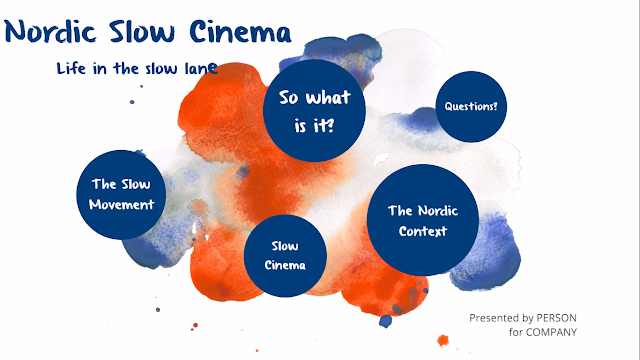
Nordic Slow Cinema : Life in the Slow Lane  (Click on the image or this link and wait for loading which is appropriately slow) interactive animation by Bella Wodzka (16 November 2017) The Slow Mouvement So What is it? Slow Cinema The Nordic Context Questions?

CCC 2010-2019 Decade Top10

Image
This blog about Contemporary Contemplative Cinema is 14 years old in 2020, and cinema still gives us more contemplative films every year. (See Recommended CCC ). If anything this narrative mode is getting bigger and wider. LEt's see what the CCC masters will show us for the new decade to come... So here is my Top10 of the past decade 2010-2019 : The Turin Horse  (2011/Béla TARR & Agnès HRANITZKY) Uncle Boonmee...  (2010/WEERASETHAKUL) Three Sisters  (2012/WANG Bing) A Pigeon Sat On A Branch...  (2014/ANDERSSON)  No Home Movie  (2015/AKERMAN) Leviathan  (2012/PARAVEL/CASTAING-TAYLOR) An Elephant Sitting Still  (2018/HU Bo) Le Quattro Volte  (2010/FRAMMARTINO) Inland Sea  (2018/SODA) Under The Skin  (2013/GLAZER) If you're still reading this blog, if you're still watching CCC, what are your personal Top of the decade, please leave a comment. Related : My CCC Top10 Canon (2012) CCC...

Interview with Observational filmmakers Kazuhiro SODA & Kiyoko KASHIWAGI

Image
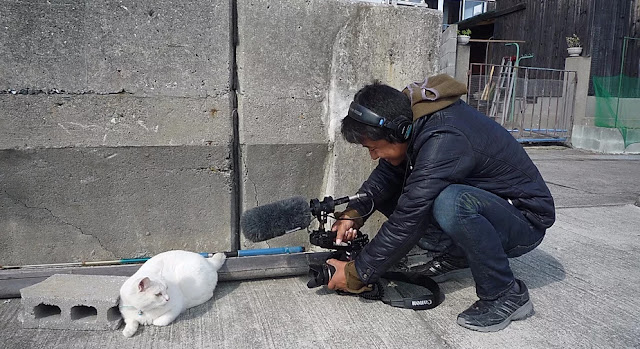
On the occasion of the release of Inland Sea on digital platforms (25 November 2019), Rock Salt Releasing contacted me to review it and offered me to interview the filmmaker Mr. Kazuhiro SODA and his producer and wife Kiyoko KASHIWAGI. Both are working jointly since  Mental  (2008; Observational Film #2).You may find his other films on his website  (at Laboratory X).   Kazuhiro SODA used to be a director-editor of 20 min TV documentaries for the NHK, between 1997 and 2004 : a series of over thirty portraits of NewYorkers. But the intensive TV practice and timing was everything he didn't want to do. Thus he conjured up his " Ten Commandments of Observational Filmmaking " and went on to produce his own feature length films independently (self-financed, directed, edited and never scripted). Trained as a fiction director, his vocation for documentaries was initiated by the films of Frederick Wiseman.  I could draw parallels between some of his films and Fre...