Posts

Blogathon 2008

Contemplative Cinema Blogathon (6-13 January 2008)   CONTRIBUTIONS 2008 The Wind Blows Where It Will by Tucker (at PilgrimAkimbo ) Kagadanan Sa Banwaan Ning Mga Engkanto (2007) by Oggs Cruz (at Lessons From the School of Inattention ) Autohystoria (2007) by Oggs Cruz (at Lessons From the School of Inattention ) Voices, Tilted Screens and Extended Scenes of Loneliness: Filipinos in High Definition (2007) by Oggs Cruz (at Lessons From the School of Inattention ) Dialogue vs. Duplicity: Notes on Syndromes and a Century and I Don't Want To Sleep Alone by Ryland Walker Knight (at The House Next Door ) The Grit of Postsocialist Discourse: Aesthetic Realism in Jia ZhangKe's Platform and Unknown Pleasures by Edwin Mak (at Faster than instant noodles ) Wrong Move & our institution of high art by Tucker (at PilgrimAkimbo ) Huling Balyan ng Buhi (2006) by Oggs Cruz (at Lessons From the School of Inattention ) Blessed are meek - The kite runner (2007) by Acumensch (at aeconom...

CCC week opening

CONTEMPLATIVE BLOGATHON 2 Sunday 6th - Sunday 13th, January 2008 Contemporary Contemplative Cinema (a.k.a. CCC, take note) is mostly known and admired for its distinctive camerawork, pace, silence and visual style (long takes, stationary shots, landscapes). Yet I realize I always come back to narrative typologies when attempting to define this loose family of filmmakers, especially in reference to the mainstream codes of storytelling. Even though I'm usually a visual kind of spectator, with a visual memory and a penchant for mise-en-scene and composition, rather than music, plot and narrative content. But this trend I feel strongly about, without being able to delimited it yet, seems to me now to be a narrative breakthrough after all, rather than a truly visual novelty. Its aesthetism is largely shared with silent cinema mise-en-scene and the cinematography developed by the (modernist) precursors of the 60ies ( which we discussed a lot last year ). But on a narrative basis, I beli...

Blogathon Banners

Image
Wide banner : 600 * 107 pix Standard banner : 449 * 172 pix Mini banner : 152* 50 pix

The Wind Blows Where It Will

Image
This post originally appeared over at PilgrimAkimbo on December 17th, 2007. Unconsciousness of despair is like unconsciousness of dread: the dread characteristic of spiritlessness is recognizable precisely by the spiritless sense of security; but nevertheless dread is at the bottom of it, and when the enchantment of illusion is broken, when existence begins to totter, then too does despair manifest itself as that which was at the bottom. -Kierkegaard, from The Sickness unto Death What is a life without faith? Is it possible for such a life to sustain itself? The history of film is replete with stories of characters wrestling with who they are and what it is they truly believe. We don't get tired of such films, if they are honest, for that struggle is deep within each of us as well. Our souls resonate with that struggle. Maybe it's because we all know something about the dread at the bottom, even when we construct lives designed to deny it. In Kunal Mehra's new film The Win...

Non-narrative film criticism

Obscure Objects of Desire: A Jam Session on Non-Narrative By Raymond Durgnat, David Ehrenstein and Jonathan Rosenbaum (Film Comment, July-August 1978) available online at Light Sleeper . Adrian Martin recommended me this roundtable organised by Jonathan Rosenbaum, 30 years ago, precisely on one of the theme I wanted to expand upon on this upcoming blogathon. So it will be a very valuable preparatory reading for further discussions. Although the premise of their discussion is about writing non-narrative reviews without making sense of an eventual plot, in films either non-linear (mainstream) or nonsensical (Avant Garde), most of what they bring forth could as well apply to C.C.C. (where narrative is rather minimalistic than actually non-linear or nonsensical). The point being to approach cinema from a visual sensibility, opposed to the literary framework of a plot-driven synopsis. Note : A survey of the various typologies of plot structures in CCC would be another interesting study to n...

Contemplative Blogathon 2

Sunday 6th - Sunday 13th, January 2008 second week of 2008 Nearly a year since the experiment at Unspoken Cinema , to run a blogathon over a month on a team-blog. It was a great success then. Hopefully we can repeat this enthousiastic event once again. This anniversary will be an opportunity to bring forth another series of ideas and posts to discuss this type of cinema. What are the new films since last year? What are the new developments of this trend? I hope that we haven't said everything that had to be said about " Contemporary Contemplative Cinema " (C.C.C.) yet. This time it will take place over the course of a week only (I somehow expect fewer participations) . And we'll meet on this team-blog (which is working better than last time around). So if you're interested request to join the members to be able to cross-post your contributions here. In a spirit of continuity and long-term memory to fight the currency-driven format of the blogosphere, I propose to ...

Pedro Costa by Rosenbaum

A great introduction to the radical cinema of Pedro Costa by Jonathan Rosenbaum at the Chicago Reader on the occasion of a retrospective. And I highlight here the excerpts dealing with his contemplative traits, and I like a lot how Rosenbaum talks about it. Still Lives: The Films of Pedro Costa by Jonathan Rosenbaum, November 15, 2007 (read the full article at Chicago Reader ) Portuguese filmmaker Pedro Costa twists Hollywood inspiration in his tableaux of dispossession and poverty. “ At the same time, quietly telling whoever will listen that cinema is exactly the opposite of what 99% of the film world thinks, and he is getting more radical every day .” (Quintín on Costa cited by JR) "The cinema of Portuguese filmmaker Pedro Costa is populated not so much by characters in the literary sense as by raw essences—souls, if you will. This is a trait he shares with other masters of portraiture, including Robert Bresson, Charlie Chaplin, Jacques Demy, Alexander Dovzhenko, Carl Dreyer, Ke...

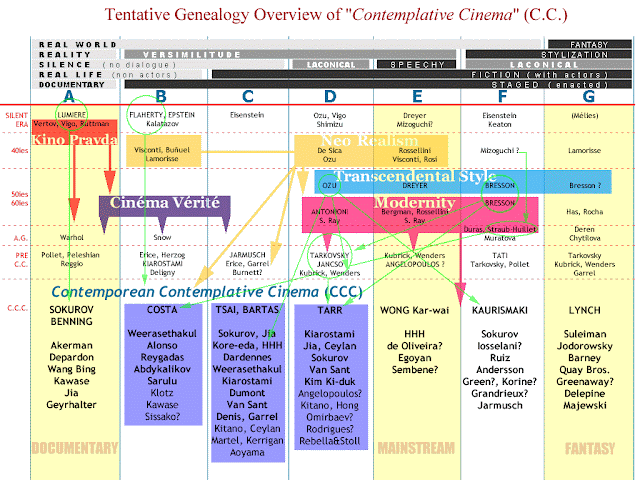
Updated genealogy chart

Image
Here is the revisited, revamped chart of the tentative genealogy for CC that I did last year for the blogathon 2007. The old chart is there . I've changed a few things and added some names. But it's still the same schemas. The question marks are directors I'm not sure where to place. If you have any suggestions, please leave a comment. Criticism of this classification is of course welcome (that's one way to look at this trend and there are probably other ways to represent this selective history that are more productive). It's interesting to note how CC seems to mend the blurry fence between documentary and mainstream narrative fiction. The 3 yellow columns are the most common modalities of traditional cinema. Some of the CC auteurs are listed in several column because their oeuvre covers a wide array of film types. Sokurov for example is the most versatile, as he's made films in almost every column (even where I didn't cite his name). But other CC ...

Review Of Trilogy: The Weeping Meadow

Copyright © by Dan Schneider Of the three Theo Angelopoulos films that I have watched, currently available on American DVDs, all have been truly great films. 1988’s Landscape In The Mist is a terrific tale of two children on an unattainable quest; 1998’s Eternity And A Day is a great film dealing with the complexities of imminent death; but, having just watched his most recently completed film, 2004’s Trilogy: The Weeping Meadow ( Trilogia I: To Livadi Pou Dakryzei ), I can honestly say, ‘There’s great, and then there’s Great!’ As excellent as the first two films are, this film is superior in almost all ways- from the camera movements and screen compositions, to the acting and character development, to the most basic elements of the picaresque story. Fortunately, many European critics agreed, and it won the 2004 European Film Academy Critics Award. In some ways, this film takes the best parts of the work of Federico Fellini, Terrence Malick, and Michelangelo Antonioni, and ...

Bresson by CC filmmakers

Robert Bresson: Alias Grace ( Sight & Sound Nov 2007) CC filmmakers, Bruno Dumont and Aki Kaurismaki (among others) were questioned about their relation to Robert Bresson. Bruno Dumont Q : What is Bresson's significance for you? BD : (...) Another thing I admire is his direction of actors: this element in his films that seems blank or neutral but in fact involves a great deal of artifice. The way he works with his actors, and recounts the story through their eyes, is achieved by demanding and authoritative processes that result in a lesson in how to be exacting, how to make cinema with limited means.(...) What I found in Bresson is a form of cinema that's austere and sombre, that makes us look inside ourselves and examine our own lives, that has a philosophical dimension which is no longer present in the general entertainments of cinema. It has the same heightened style and grandeur you find in great tragedy. Q : What, if anything, have you borrowed from Bresson's cine...

Nineteenth century melodrama

Peter Kubelka (austrian Avant Garde), in an interview at Film-makers' Coop : "I discovered that commercial cinema did not use the possibilities which are in this medium. The commercial film industry use film like a secondary art, a reproduction of theatre, novels, melodramas. You have people who act as if they are somebody else, called actors. And then you have somebody who has written their words for them, they do this and it's recorded. Then somebody plays some music with it in order to create emotions with the people who sees. That's XIXth century melodrama, and it has not changed up to now. And the story are always the same : boy meets girls, difficulties, happy end. Which is fantastic. It shows that commercial cinema is something else. It has taken the place of the church in a way. It gives you recipes how to live, do you choose this way or that way, which is all shown to you on the screen." Kubelka is opposing Avant Garde films to Narrative Cinema, of cours...

DVD Review Of Eternity And A Day

Copyright © by Dan Schneider The 1998 film by Greek director Theo Angelopoulos, Eternity And A Day ( Mia Aioniotita Kai Mia Mera or Μια αιωνιότητα και μια μέρα ), is not merely another film about a supposed poet wherein the art of poetry and the act of poesizing are never on display. Yes, it’s true that, technically, neither are onscreen, but it is a superior film about a supposed poet wherein the art of poetry and the act of poesizing are never on display, for the film does capture the dead cliché of ‘a soul of a poet’ as well as just about any I’ve ever seen. It does it with imagery, and Angelopoulos’s patented long takes, but it does capture it, and exceedingly well. The film was not only directed by Angelopoulos, but he wrote the screenplay. That it won that year’s Cannes Film Festival’s coveted Palm D’Or shows that, sometimes, quality still counts. The tale subtly weaves the past, present, and future tenses of a dying man, the bearded poet Alexander (Bruno Ganz, best k...

Satantango by Rosenbaum

Already cited in a previous post , The Importance of Being Sarcastic : Satantango , review by Jonathan Rosenbaum ( Chicago Reader , October 14, 1994, also in Essential Cinema ) : "(...) So far I could almost be describing a painting. But even though the action of Satantango covers only two consecutive fall days, followed by a couple of mordant epilogues occurring later the same month, this is a narrative constantly in motion -- at least in the way we experience it -- thanks to Tarr's elaborately choreographed camera style and respect for duration. Filmed in extremely long takes, the movie makes us share a lot of time as well as space with its characters, and the overall effect is to give a moral weight as well as narrative weight to every shot: as detestable as these people are, we're so fully with them for such extended stretches that we can't help but feel deeply involved, even implicated in their various manoeuvres. (This is somewhat less true of Tarr's two imp...