Posts

Showing posts with the label film review

My review of Abdul Rahman's 8th Street

Image
The old man (Venkatesan) 8th Street (2026/Abdul RAHMAN/India) 1h Film review by Benoit Rouilly for Unspoken Cinema (containing spoilers voluntarily). A clean, well directed piece by Abdul Rahman, who in just one contemplative hour and three cryptic chapters, evokes the devious outlines of five mysterious stories within four opaque characters… Some stories will remain unresolved as others stand open-ended. Everything takes place, practically in real time around 2am, in a single night-bar, named “8th Street”. A lovely place, with marble pedestal tables, wooden chairs and comfy booths. There are rounded corners to the door-frames like on a boat. Coffee bean wooden patterns form a see through ceiling. And a neo-classical sepia painting on the back wall, representing customers at coffee tables, completes the atmosphere. The protagonist enters the bar last, a clean, well lighted place, and penetrates by the front door this “huis-clos” (=a single action takes place in a single space behind c...

I Reject The Invitation From God (Abdul Rahman) Film review

Image
  I Reject The Invitation From God | Missed Movies (YouTube) 45'35" (Missed Movies) 12 March 2020 Written - Directed - Edited by Abdul Rahman Tamil (subtitled in English) My review: I Reject The Invitation From God (2019/Abdul Rahman/India) 45’ One widower patiently awakes from a comatose sleep on the unmade bed, at the insistent sound of an old fashioned ringtone. His body lies face up and stretched out like a corpse. Slowly, very slowly, he sits up and rubs his bearded face, like the weight of the years bearing on his shoulders, numbing his whole body, his every joint. He speaks no words, since he lives on his own and sees no one all day. The film title reveals everything from the start. But when will it happen? What are we looking at? A dream? A miracle? Or just another day?  Abdul Rahman’s fourth short film opens slowly and without speech (the first word uttered comes out right before 7’ 30”). The shots are long and almost always static, but we enjoy partaking in the pro...

Valley Time (a film review of Ian Darling's The Valley, 2026)

Image
“Valley Time” is a peculiar pace of life. Such life is nonchalant, carefree, and at times delightfully indifferent. Adopted by the residents of the village of Kangaroo Valley (shy of 900 souls) strung along the meandering Kangaroo river, nestled amongst rocky sandstone cliffs. This secluded settlement sits a mere two-hour drive south of Sydney, in Australia. Throughout this silent landscape, distances stretch vast until the next neighbour. Community is bound not by proximity, but by a shared introspective state of mind. Such space is unique to the mountainous and isolated terrains. Such pace is unique to the insulated people living far apart yearning for each other.  The documentary The Valley (2026) crafts a multifaceted, deeply evocative portrait of this remote enclave over the course of 3 hours. It shifts from one dairy farmer/painter to a gardener cultivating vegetables to a baker kneading dough to lonesome locals running errands… and so on, and so forth. A seamless human tape...

MASTERCLASS Bruno Dumont (Quinzaine des cinéastes 2026)

Image
  MASTERCLASS Bruno Dumont (YouTube) 54'16" (Quinzaine des cinéastes) 21 mai 2026 Lire aussi: Dumont, Année Zéro (Critikat, Josué Morel, 20 mai 2026)

La Libertad Doble (Critikat)

Image
  Cannes 2026 - La Libertad Doble de Lisandro Alonso (YouTube) 14'49" (Critikat) 17 mai 2026 Avec : Josué Morel et Robin Vaz Voir aussi: La Libertad retrouvée (Critikat)

Béla TARR (revue de presse 2026)

Aujourd'hui 6 février 2026, jour des funérailles de Béla TARR, génie du Cinéma Contemplatif, à Budapest, un hommage dans la presse française :  "[..] Parler de salut de l’humanité ou de résistance paraît trop lourd, trop chargé pour désigner avec justesse leurs comportements : ils ne projettent rien vers l’avenir, ne portent aucune utopie, mais persistent à accomplir une action simple, minimale. Et pourtant, c’est peut-être bien à travers ces gestes que subsiste pour eux une dernière forme de dignité possible, alors qu’advient la fin des temps." Robin Vaz ; Béla Tarr, le brouillard a envahi ton âme. Ciao Béla . (in Critikat ) "[..] Dans le documentaire Tarr Béla : I Used to be a Filmmaker de Jean-Marc Lamoure, on voit notamment le cinéaste sur le tournage en train de préparer un plan sur la carriole qui passe au loin, sur la crête d’une colline. Pour obtenir son cadre, Tarr demande à des membres de son équipe de creuser un trou : « C’est mon dernier film, j’enterre l...

Hamvas Béla út 11. (Janos KIS)

Image
Hamvas Béla út 11. (YouTube) 55'36" (Kis ZenFilms) 15 Jan 2026 * * * Hamvas Béla út 11. / Hamvas Béla street 11. (2025/Janos KIS/Hungary) a review by Benoit Rouilly Living the weight of an hour, a man takes us through the mundanity of unfettered existence. How much does an hour of human life weigh? Eight moments, eight plans-séquence tell the tale of a daily routine. The slightest gesture is well-rehearsed by life-long habits, not even conscious or calculated. A prosaic choreography of solitude takes place before our eyes. Not a single word is uttered as the unnamed protagonist undertakes repetitive chores. This individual is all of us when nobody’s watching. The muscle memory of his alienation draws lonely circles throughout his apartment. It is as much a chronicle of his life than it is a document of his living space. A modest home on the 13th floor in a Budapest social project from the 60ies. A socialist-era prefab apartment block. The washed-out facade is a vertiginous p...

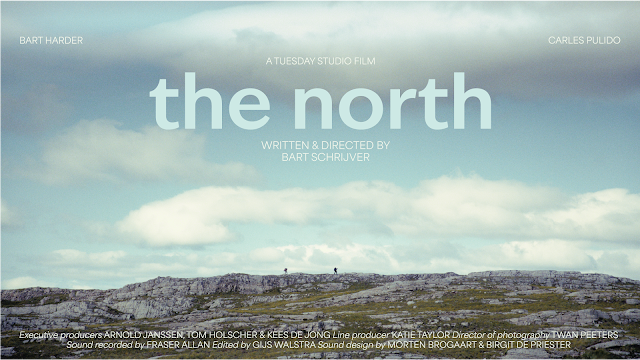
Feet on a relentless path, headspace in a cloud (film review: The North)

Image
The North (2025/Bart Schrijver/Netherlands) The highlands, right in between the clouds and the mountains. Two friends, and solitude all along the way… There was only one goal: reaching the northernmost cape of Scotland from Glasgow, 600 km on foot through the rough terrain, barren or wet wilderness, during extreme atmospheric conditions. Was it a dare, a bucket list or a dream? Chris (Bart Harder) and Lluis (Carles Pulido), former roommates, decided to set apart 30 days from their busy lives and accomplish this adventure together. We don’t know who they are, where they come from, what they want to become… but we’ll discover it, along with them, on the way to Cape Wrath. After a blind phone conversation from the past (as if recorded on an answering machine) of two students planning a farewell party, like a usual “Tuesday night” of drinking at the pub, the film cleverly flashes forward right away to a decade later. All we know about them through this phone call overture is that they use...

An Elephant Sitting Still (Kinotherapy Movies) Review

Image
  An Elephant Sitting Still - a Single Review (YouTube) 14'10" (Kinotherapy Movies) 27 dec 2024 "Hu Bo's only feature, "An Elephant Sitting Still" quickly resonated with film lovers worldwide and found it's place in the cinematic canon. This 4 hour intimate excursion through pain and suffering is one of the most beautiful movies I've ever seen and is an unequivocal masterpiece. Immersive cinematography and Buddhist philosophy elevate this film to a transcendent level along the ranks of Tarkovsky, Bergman, Fellini, Malick, Tarr, or Weerasethakul. It is undeniably heart-wrenching and gloomy, yet it is rewarding, honest, and an experience that will long escape your mind."

Dahomey (Mati Diop) X Les Statues meurent aussi (Marker/Resnais)

Image
De Les Statues Meurent aussi (1953) à Dahomey (2024) À soixante-dix ans d'intervalle, deux documentaires interrogent les rapports entre la France et la culture africaine à travers le prisme de la colonisation. Cette analyse compare Les Statues meurent aussi  (1953) de Chris Marker et Alain Resnais, et Dahomey (2024) de Mati Diop, ce dernier s'inscrivant explicitement dans la lignée du premier, qualifié par Diop de "manifeste politique en même temps qu'un film d'art." Nous verrons comment ces deux essais filmiques se rapprochent et comment ils diffèrent, appartenant à deux générations différentes de l'histoire du cinéma. À la fin du XIXe siècle (1892), l'empire colonial français accumule près de 7000 objets provenant d'Afrique (et d'Océanie aussi) dans ses musées métropolitains, fruits de pillages masqués sous l'apparence de "cadeaux" dans un contexte de domination coloniale. Si  Les Statues meurent aussi  émerge dans une périod...

Transmigrating Souls of WEERASETHAKUL (Sabzian)

Image
Many texts collected in English and Dutch on the cinema of Weerasethakul at Sabzian... For him, cinema is the artform that can address the mysteries of time and that creates a shared body of memories. Cinema is a time machine to him, in part technical, partly magical. “I am interested in exploring the innards of this time machine. There might be some mysterious forces waiting to be revealed just as certain things that used to be called black magic have been shown to be scientific facts. For me, filmmaking remains a source all of whose energy we haven’t properly utilized. In the same way that we have not thoroughly explained the inner workings of the mind.”   Transmigrating Souls: The Cinema of Apichatpong WEERASETHAKUL (Sabzian)

Eureka (Lisandro Alonso) capsule by Peter Bradshaw

Image
  PETER BRADSHOW reviews EUREKA (YouTube) 4'37" Peter Bradshaw (17 Jan 2024)

Perfect Days (Wenders) review

Image
  It's by the sound, from the street, of a traditional twig broom brushing away leaves from the pavement at dawn that this man awakens. He methodically folds back his futon and duvet in his neat tatami room, gently puts away the book he abandonned last night next to his reading glasses... He walks downstairs to brush his teeth and climbs back upstairs with a water sprayer to water his plants in the adjacent room bathed in a sepia shade. He puts on his work overalls with "Tokyo Toilets" printed on the back. Without a word uttered so far, the personality of the character is established with a natural flow and a few hints...  He proceeds down the stairs where he picks up one by one the objects carefully placed on a shelf. First his mobile phone after disconnecting it from an all-night charge. 2 sets of keys he pockets promptly. Some change. Only his watch remains on the shelf when he closed the door. The first thing he looks at when opening the entrance door is the sky. Next...

Menus-Plaisirs (Wiseman) review

Image
Menus-Plaisirs : Les Troisgros (2023) Frederick WISEMAN What you ought to know prior to watching this film The less information about this film, the more surprises the slow-burn discovery will get you, each step of the way. The faces of these chefs might not be familiar at first, but they’ll gradually grow on you… until you’re part of the family by the end. You might want to save a good moment of your time to complete this four-hour long observational documentary, as there is no built-in intermission. Like for all Wiseman’s recent films, this film spends longer than usual to foster acquaintance with the universe he’s studying. He observes carefully, patiently, the institutions of society and culture, one at the time, with a no-nonsense title naming its subject with exactitude. What you won’t see in this film: emotional music score, voiceover commentary, stars, competition, prices, money, waiting line, shouting orders, gratuitous insults, tears of despair or joy, food reviews, Instagra...

GPT4 talks about CCC

Image
  In January, I asked GPT 3.5 about Contemplative Cinema . Now GPT 4, who is smarter than GPT 3.5 (and not as smart as GPT5, rumored to be released on december 2023), is embedded with Bing (in the web browser Edge), and answers any prompts after consulting a Bing web search. Today, I'll ask GPT 4 the same questions and compare the answers... Illustration generated by an AI (Adobe Express), prompt: "image of Contemplative Cinema" Prompt: What is the definition of Contemplative Cinema? GPT4 : "Contemplative Cinema, also known as Slow Cinema, is a genre of art cinema film-making that emphasizes long takes and is typically characterized by a style that is minimalist, observational, and with little or no narrative. In these films, there may be very little action or events. Car chases, combat scenes, violence, gunshots are either anecdotal or non-existent. Yet, it’s impossible to look away. These films take their time to establish the plot. Some have very few dialogues, ot...