Posts

Showing posts with the label hyperrealism

The Sealed Soil (Sepideh Amiri)

Latest addition to the Library page at Unspoken Cinema: "Society typically dictates the duration and manner in which we attend to objects, people, or events. In other words, the length and type of our attention are regulated by unwritten rules of behavior, forming a part of the social order. When someone focuses on something longer than usual, particularly something socially or aesthetically marginalized, it can challenge established social orders. When attention is prolonged beyond customary social norms, the usual controls over how we observe and perceive can be temporarily suspended, disrupting habitual modes of perception. Slow cinema filmmakers slow down the rhythm of the film and extend shots to encourage this sustained attention. Through slowness, they not only slow the narrative but also challenge social norms and how we typically engage with what we see." Amiri, Sepideh;  Marvā Nabīlī’s The Sealed Soil as Slow Cinema . In Cinema Iranica . Encyclopaedia Iranica Foun...

HKIFF50: Interview with Tsai Ming-liang (Deep Cut)

Image
  139. HKIFF50: Interview with Tsai Ming-liang (Deep Cut) 27'38" ENGLISH 5 july 2026 "The seventh and final director interview Wilson conducted at this year’s Hong Kong International Film Festival is with the legendary Taiwanese filmmaker Tsai Ming-liang. Wilson asks one of his cinematic heroes about the state of filmmaking today, his methods for working with actors, and his decades-long collaboration with Lee Kang-sheng."

My review of Abdul Rahman's 8th Street

Image
The old man (Venkatesan) 8th Street (2026/Abdul RAHMAN/India) 1h Film review by Benoit Rouilly for Unspoken Cinema (containing spoilers voluntarily). A clean, well directed piece by Abdul Rahman, who in just one contemplative hour and three cryptic chapters, evokes the devious outlines of five mysterious stories within four opaque characters… Some stories will remain unresolved as others stand open-ended. Everything takes place, practically in real time around 2am, in a single night-bar, named “8th Street”. A lovely place, with marble pedestal tables, wooden chairs and comfy booths. There are rounded corners to the door-frames like on a boat. Coffee bean wooden patterns form a see through ceiling. And a neo-classical sepia painting on the back wall, representing customers at coffee tables, completes the atmosphere. The protagonist enters the bar last, a clean, well lighted place, and penetrates by the front door this “huis-clos” (=a single action takes place in a single space behind c...

Valley Time (a film review of Ian Darling's The Valley, 2026)

Image
“Valley Time” is a peculiar pace of life. Such life is nonchalant, carefree, and at times delightfully indifferent. Adopted by the residents of the village of Kangaroo Valley (shy of 900 souls) strung along the meandering Kangaroo river, nestled amongst rocky sandstone cliffs. This secluded settlement sits a mere two-hour drive south of Sydney, in Australia. Throughout this silent landscape, distances stretch vast until the next neighbour. Community is bound not by proximity, but by a shared introspective state of mind. Such space is unique to the mountainous and isolated terrains. Such pace is unique to the insulated people living far apart yearning for each other.  The documentary The Valley (2026) crafts a multifaceted, deeply evocative portrait of this remote enclave over the course of 3 hours. It shifts from one dairy farmer/painter to a gardener cultivating vegetables to a baker kneading dough to lonesome locals running errands… and so on, and so forth. A seamless human tape...

Jeanne Dielman: Hyperrealism of Everyday (Arthur Tuoto)

Image
  JEANNE DIELMAN (1975): A Hiper-realidade do Cotidiano (YouTube) 34'46" (Arthur Tuoto) 13 Feb 2026 "Jeanne Dielman acompanha três dias da rotina rigorosa de uma viúva em Bruxelas, cuja vida é sustentada por um duplo trabalho doméstico e sexual. Aos poucos, pequenas falhas nesse cotidiano começam a corroer essa ordem e revelam como o tempo, o espaço e os objetos passam a agir contra ela. A aula destaca como Chantal Akerman transforma tarefas banais em matéria dramática, hipervisibiliza o trabalho invisível das mulheres e subverte o naturalismo clássico ao dilatar planos e construir uma “hiper-realidade” formal."

Hamvas Béla út 11. (Janos KIS)

Image
Hamvas Béla út 11. (YouTube) 55'36" (Kis ZenFilms) 15 Jan 2026 * * * Hamvas Béla út 11. / Hamvas Béla street 11. (2025/Janos KIS/Hungary) a review by Benoit Rouilly Living the weight of an hour, a man takes us through the mundanity of unfettered existence. How much does an hour of human life weigh? Eight moments, eight plans-séquence tell the tale of a daily routine. The slightest gesture is well-rehearsed by life-long habits, not even conscious or calculated. A prosaic choreography of solitude takes place before our eyes. Not a single word is uttered as the unnamed protagonist undertakes repetitive chores. This individual is all of us when nobody’s watching. The muscle memory of his alienation draws lonely circles throughout his apartment. It is as much a chronicle of his life than it is a document of his living space. A modest home on the 13th floor in a Budapest social project from the 60ies. A socialist-era prefab apartment block. The washed-out facade is a vertiginous p...

The Enigma of Terrence Malick (Auteur Cinema)

Image
  The Enigma of Terrence Malick (YouTube) 19'20" (Auteur Cinema) Nov 1st 2025

Mono no Aware: Contemplative Filmmaking in Zen Aesthetics (7)

Image
 Claude Sonnet 4.0:  These essays explore how ancient Japanese aesthetic principles illuminate the art of contemplative cinema. Through pregnant silences, intentional asymmetries, elevation of the ordinary, strategic concealment, natural authenticity, understated refinement, and bittersweet impermanence, we discover how Zen wisdom transforms the moving image into a vehicle for deeper seeing and mindful presence. Each principle offers filmmakers and viewers alike a pathway to cinema that contemplates rather than consumes, revealing profound truths through patient observation and aesthetic restraint. 物の哀れ MONO NO AWARE Bittersweet awareness of impermanence Mono No Aware, literally meaning "the pathos of things," represents the aesthetic principle that finds beauty in the transient nature of existence and the bittersweet awareness of impermanence that underlies all experience. Unlike Western philosophical traditions that often view change as loss or failure to achieve permanence...

Feet on a relentless path, headspace in a cloud (film review: The North)

Image
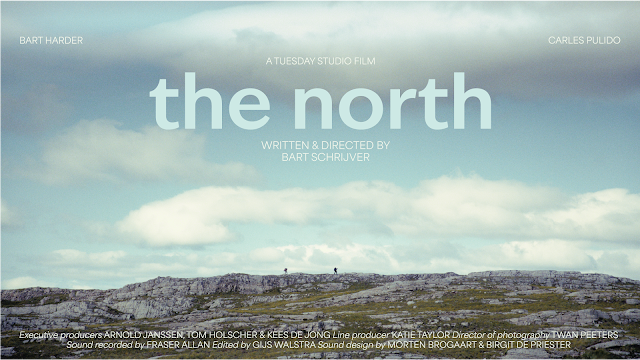
The North (2025/Bart Schrijver/Netherlands) The highlands, right in between the clouds and the mountains. Two friends, and solitude all along the way… There was only one goal: reaching the northernmost cape of Scotland from Glasgow, 600 km on foot through the rough terrain, barren or wet wilderness, during extreme atmospheric conditions. Was it a dare, a bucket list or a dream? Chris (Bart Harder) and Lluis (Carles Pulido), former roommates, decided to set apart 30 days from their busy lives and accomplish this adventure together. We don’t know who they are, where they come from, what they want to become… but we’ll discover it, along with them, on the way to Cape Wrath. After a blind phone conversation from the past (as if recorded on an answering machine) of two students planning a farewell party, like a usual “Tuesday night” of drinking at the pub, the film cleverly flashes forward right away to a decade later. All we know about them through this phone call overture is that they use...

Zen Concepts in Contemplative Performance (2): Iki

Image
  Claude Sonnet 4.0: The intersection of Japanese Zen aesthetics and contemplative cinema reveals profound possibilities for performance that transcend conventional Western acting methodologies. Four essential concepts operate within a complementary theoretical framework: Danshari functions as a foundational methodology for conscious elimination, Iki and Seijaku work as experiential principles governing refined presence, while Yuugen represents the atmospheric mystery that emerges from their synthesis. Together, they create a triadic model progressing from methodological preparation through embodied execution to perceptual reception, challenging performers to locate truth through restraint rather than demonstration and essential simplicity rather than elaborate character construction. 粋 IKI Understated Elegance Iki represents an aesthetic philosophy that finds sophisticated beauty in restraint, elegance in understatement, and refinement through the conscious rejection of exces...

Convenience vs Contemplation (Cinematic tropes)

Image
After a discussion with Claude Sonnet 3.7, I (or we) came up with these following dichotomy lists contrasting Mainstream Cinema and Contemplative Cinema... In the complex tapestry of contemporary cinematic discourse, mainstream cinema consistently employs a sophisticated architecture of narrative devices that privilege emotional resonance and dramatic efficiency over verisimilitude. These instrumental conveniences—far from being mere technical shortcuts—constitute a distinct visual grammar through which normative cinema mediates our relationship with reality itself. The manipulation of time and chance, the universalization of personal experience, narrative conveniences, and superlative effects collectively represent not simply storytelling techniques, but rather a comprehensive epistemological framework. This framework fundamentally shapes how audiences perceive, process, and integrate fictional experiences within their understanding of the lived world. The following examination interr...

More Like This (3) Cow

Image
Watch More Like This Film: Cow (2021/ARNOLD)  keywords = Domesticated animals + (Human) + Mutism (* = non-contemplative film) More cow’s viewpoint: Bovines (2011/Gras) More ancient: Old Partner (2008/Lee Chung-Ryul) More like a zoo: Bestiaire (2012/Côté) More goats: Quattro Volte (2010/Frammartino) More sheep: Sweetgrass (2008/Castaing-Taylor/Barbash) More sheep (lotta more): Baa Baa Land (2017/Thomas) More snow: Hiver Nomade (2012/Stürler) More farms: Gunda (2020/Kossakovsky) More jungle: Pepe (2024/Los Santos Arias) More fragmented: Cow (2007/Kiarostami) Short More western: First Cow (2019/Reichardt) *More madness: The Cow (1969/Mehrjui) More fairytale:  Bambi, l'histoire d'une vie dans les bois (2024/Fessler) *More indian: Valu (2008/Kulkarni) See also at Unspoken Cinema: CCC recommendations

Audrius STONYS (Paris 2024)

Image
(Merci à Axel Munoz pour m'avoir fait découvrir ce cinéaste lithuanien méconnu) Le cinéma contemplatif d’Audrius Stonys (Novembre 2024) BPI Une rétrospective est consacrée à la Bpi du 7 au 18 novembre 2024 au réalisateur lituanien Audrius Stonys qui porte un regard sensible sur ses contemporain·es. La caméra d’Audrius Stonys s’attarde sur le quotidien d’hommes et de femmes, leur rapport à la nature et à l’autre, mais aussi au temps qui passe. Attaché aux détails, le réalisateur filme sous différents angles, en changeant de perspectives, la vie des Lituaniens et Lituaniennes, leur histoire et leurs traditions. La musique, très présente dans son œuvre, les vues du ciel et de la terre, donnent à voir et à entendre la beauté poétique et spirituelle de la vie. Filmer, pour Audrius Stonys, est finalement une manière de conserver la trace d’existences fugaces. Le cinéma d’Audrius Stonys. Les entretiens de Balises (23/12/2024) Vidéo « Comment filmez-vous les corps ? Quelles histoires rac...

Candlelight Journaling (Sean Alan Stone)

Image
  Candlelight Journaling: A Meditative Minimalist Slow Cinema (YouTube) 14'34" (Sean Alan Stone) 9 dec 2024

Wenders's toilets film (Sefo Nad)

Image
  When a Director Is Inspired by Toilets | Perfect Days Video Essay (YouTube) 20'03" (Sefo Nad) 10 Oct 2024

Slow Cinemas Analysis (diagram)

Image
  Slow(ish) Cinema is all this! That umbrella term covers all Slow Cinemas, including CCC (Contemplative Cinema) which is only a small subset of it all. For instance, Ozu, Bresson, Antonioni, Tarkovsky, Angelopoulos, Jarmusch, Ceylan, Hong Sang-soo, Malick, are all considered part of "Slow Cinema", whereas they are excluded from Contemplative Cinema, for various reasons (as seen on the diagram). When you add up Slowness, Long Takes, Minimalism, Realism, Verisimilitude, Atmosphere, Poetry and Ennui, you get Contemplative Cinema. When you substract from Slow Cinema the following concepts : Edits, Narrative Arc, Fantasy, Staging, Politics, Monologue, Score, Dialogues, Lyricism, Words, you get Contemplative Cinema too. Slowness, Long Takes > Minimalism > Realism, Verisimilitude > Atmosphere, Poetry > Ennui >  Contemplative Cinema See also at Unspoken Cinema: CCC or Not? Starting From Basics All Over Again CCCFAQ#6: What are th...

Contemplative Core & Tectonic Plates

Image
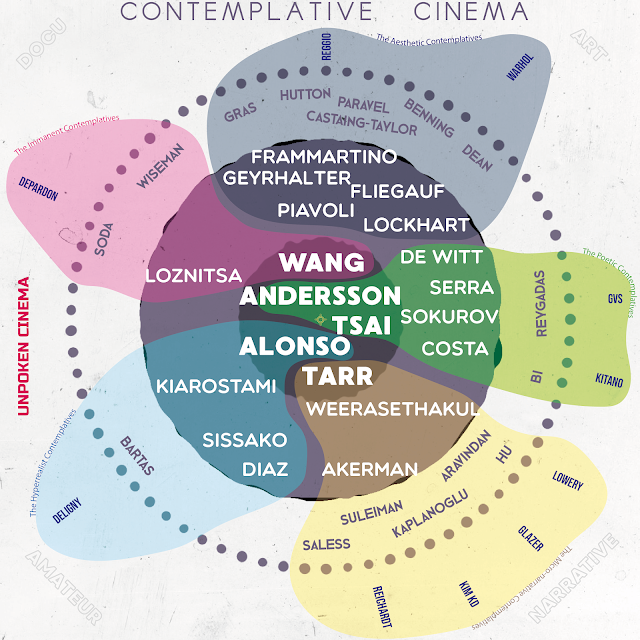
The core figures of Contemplative Cinema could be summed up by the names: WANG Bing, Roy ANDERSSON, TSAI Ming-liang, Lisandro ALONSO, and Béla TARR, for being consistently, profoundly, and magnificently contemplative... (See Iconic Directors of Contemplative Cinema ) Out of the minimalist centre radiate trustworthy rings of authentic contemplatives, up to the far reach of more conventional edges, maybe more "slow" than "contemplative”, but still minimalist. However, under this uniting banner of “Contemplative Cinema” surges the distinctive rifts between the tectonic plates of more cohesive sub-divisions… because it’s crucial to extract their diversity from their resemblance, their personality from their unity. From this widespread of satellites emerges 5 more stylistically coherent sub-families sorted by affinity tending towards "Art" (Art Gallery and Minimalist Formalism), "Narrative" (but still Minimalist), "Amateur" (Minimalist Hyperreali...

CCC FAQ #6 : What are the main features of Contemplative Cinema?

Image
Contemporary Contemplative Cinema Frequently Asked Questions #6 :  What are the main features of Contemplative Cinema ?   We could designate five aesthetic characteristics departing Contemplative Cinema from its Modernist precursors and its minimalist contemporaries (also known under the broader term of « Slow Cinema ») : 1. Exteriority First and foremost, Contemplative Cinema takes a step back and aside, to observe the protagonists and the universe from outside. The non-intrusive camera plants itself in a corner and looks on the whereabouts of people who happen to pass by. The framing of this reality is all-embrassing and captures more than is necessary to provide a solid context to each shot. The spectator scrutinizes the outer shells of mutic faces and gazes over what could have been, ruminates blindingly on what once was, contemplates lengthily on what might happen next… 2. Hyperrealism Real-life is the template. The screen is a mirror. Away from the artifice of pure ficti...